MOXIE makes oxygen out of Martian air
Perseverance carried a toaster-sized box that heated Martian carbon dioxide to 800°C and made 5.4 grams of oxygen — the first time a spacecraft manufactured a consumable on another planet.
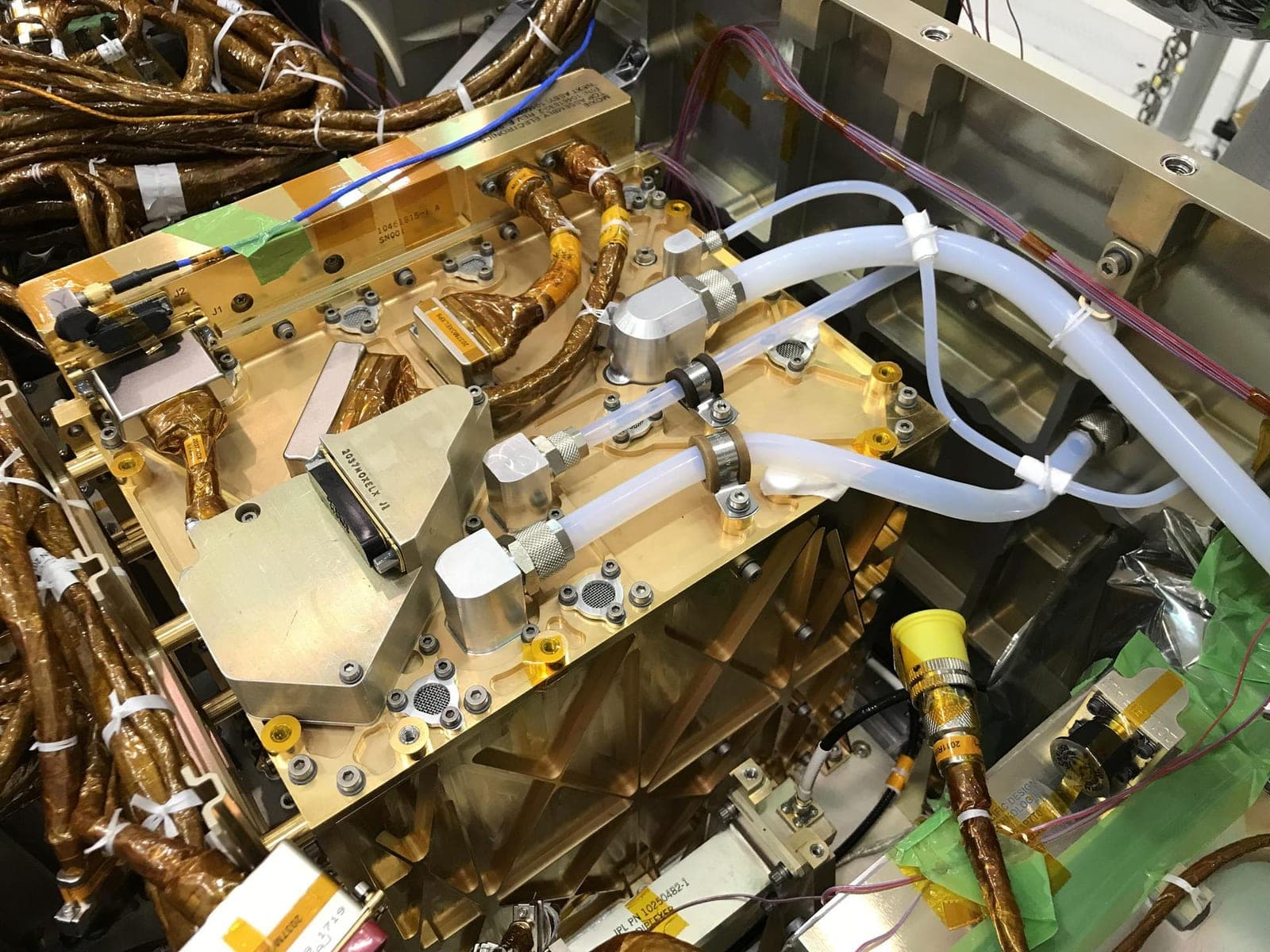
On 20 April 2021, on Perseverance's sixtieth sol, a box about the size of a toaster warmed up for two hours and then ran for one. It drew in Martian air, and it produced 5.4 grams of oxygen — about ten minutes of breathing for an astronaut doing light work. Small numbers, but the category was new. Everything any spacecraft had ever consumed on another world had been carried there from Earth.
The chemistry is not exotic; the engineering is. Mars's atmosphere is about 95 percent carbon dioxide at roughly six-tenths of one percent of Earth's sea-level pressure, so the first job is compressing a near-vacuum. MOXIE then heated the gas to around 800°C and pushed it through a solid oxide electrolysis stack, which strips one oxygen atom from each CO₂ molecule and vents the carbon monoxide overboard. Running that hot inside a rover built to survive Martian nights meant 3D-printed nickel alloy parts, aerogel insulation and a thin gold coating to keep infrared from cooking the neighbours. It was led by Michael Hecht at MIT's Haystack Observatory.
The reason anyone cares is propellant, not breathing. Getting four astronauts off Mars and back toward Earth takes something on the order of 25 tonnes of liquid oxygen for the ascent vehicle. Launching 25 tonnes of oxygen from Earth to Mars is not a rounding error on a mission budget; it is arguably the mission. Landing a one-tonne machine that makes it on arrival changes the arithmetic of every human Mars plan ever drawn.
MOXIE ran sixteen times, finishing on 7 August 2023 with a 9.8-gram run. Spread across a full Martian year, the tests deliberately covered the awkward conditions — thin morning air, dusty season, the thermal swing between day and night — and the instrument kept working through all of them. Total production was 122 grams. At its best it managed 12 grams an hour, double the design target, at 98 percent purity or better.
Now the honest part. One hundred and twenty-two grams is roughly what a small dog breathes in ten hours. A real ascent-vehicle plant would need to run continuously for more than a year at something like two hundred times MOXIE's best rate, and it would have to do the things MOXIE never attempted: filter dust indefinitely, operate unattended for fourteen months, and liquefy and store its product. MOXIE vented everything it made straight back into the atmosphere. No scaled-up version has been built, funded or scheduled. What the experiment proved is that the physics holds on Mars, which is not nothing, and is a long way short of a fuel depot.