Leopard spots in a Martian mudstone
Perseverance drilled a rock ringed with vivianite and greigite. On Earth microbes make those minerals; on Mars nobody has yet found a plain chemical route that fits.
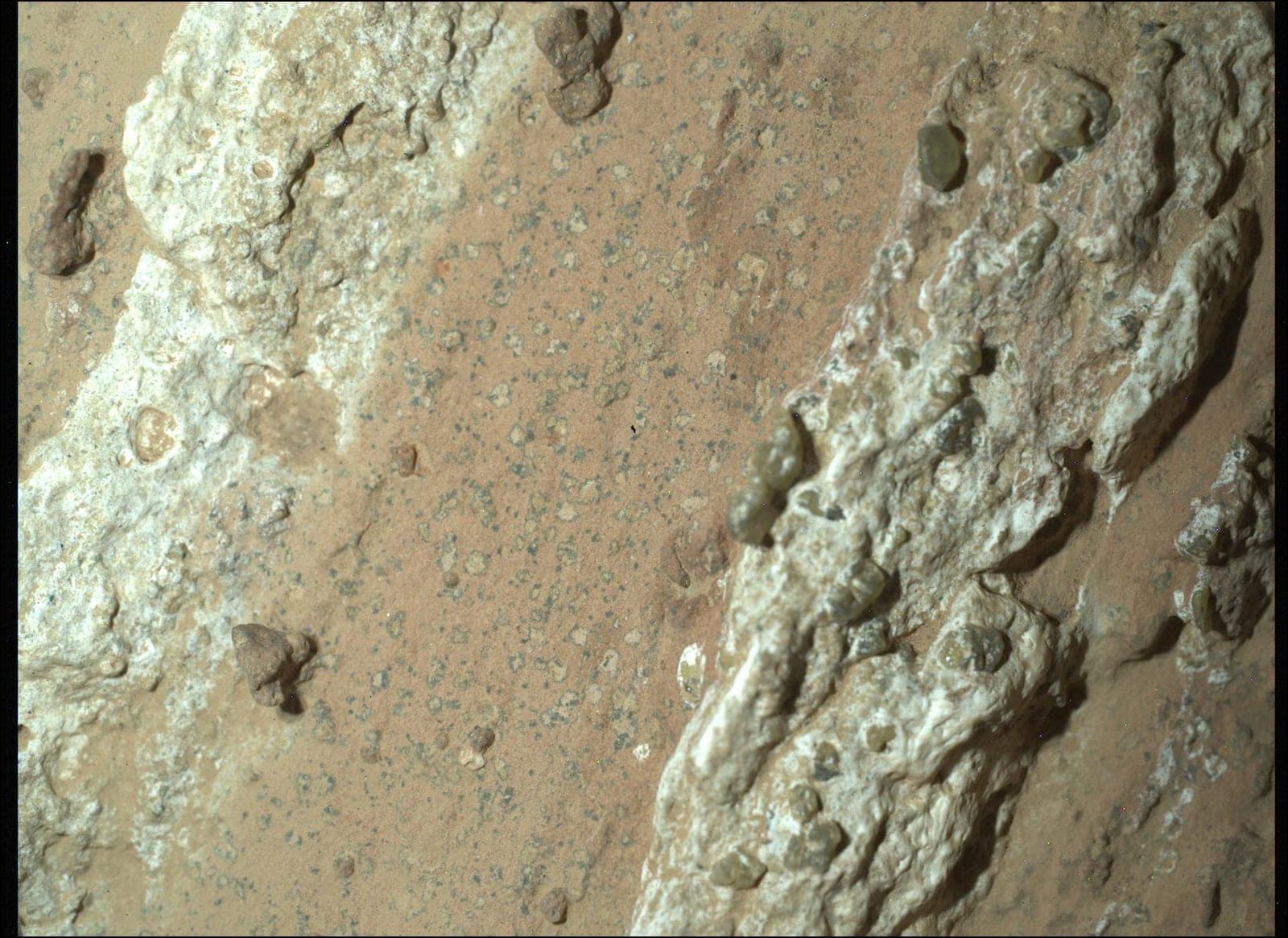
In July 2024 Perseverance was working a set of outcrops called Bright Angel, on the banks of Neretva Vallis — the 400-metre-wide channel that once poured water into Jezero crater. One arrowhead-shaped slab, roughly a metre by sixty centimetres, was covered in markings the team had not seen before: millimetre-scale dark rings with pale centres, which they called leopard spots, and a scatter of smaller black specks they called poppy seeds. The rock got the name Cheyava Falls, after an intermittent waterfall in the Grand Canyon.
The instruments made it more interesting rather than less. PIXL, which fires X-rays at a target and maps the elements point by point, found the rings enriched in iron and phosphorus. SHERLOC found organic carbon in the surrounding mudstone. A peer-reviewed analysis led by Joel Hurowitz of Stony Brook University, published in Nature on 10 September 2025, identified the minerals as vivianite — a hydrated iron phosphate — and greigite, an iron sulfide.
That combination is the reason this is a story. On Earth, vivianite turns up in waterlogged sediment, peat bogs and lake beds, and greigite is routinely produced by bacteria that make a living by moving electrons between iron and sulfur. The spots themselves look like what happens on Earth when a microbial community sets up a chemical gradient in wet mud and precipitates minerals around it. Both minerals can also form without life — but the known abiotic routes generally require sustained high temperature or strong acid, and this mudstone shows no evidence of having been cooked or steeped in either. The argument is not that biology has been demonstrated. It is that the ordinary non-biological explanations do not currently fit the rock.
NASA's formal term is "potential biosignature," a deliberately narrow category: a substance or structure that might have a biological origin, but that needs more data before anyone can say whether life was involved. It is not a fossil. There are no cells, no structures, no shapes that look like organisms. Several researchers who are not on the mission have pointed out that our catalogue of abiotic mineral chemistry on Mars is thin, and that the absence of a known non-biological pathway is an argument about the state of our knowledge as much as about the rock.
Settling it means putting the sample under instruments that will never fly — mass spectrometers that measure sulfur and carbon isotope ratios to a precision no rover can reach, and electron microscopes that resolve mineral textures at the nanometre scale. Perseverance drilled a core from Cheyava Falls and sealed it in a titanium tube. It is sample number 25, named Sapphire Canyon, and it is currently sitting inside a rover on Mars with no funded mission coming to collect it.