Ingenuity flies, then breaks its blades on a dune
A 1.8 kg helicopter hovered three metres above Jezero for forty seconds. Seventy-two flights later, featureless sand confused its navigation camera and damaged all four blades.
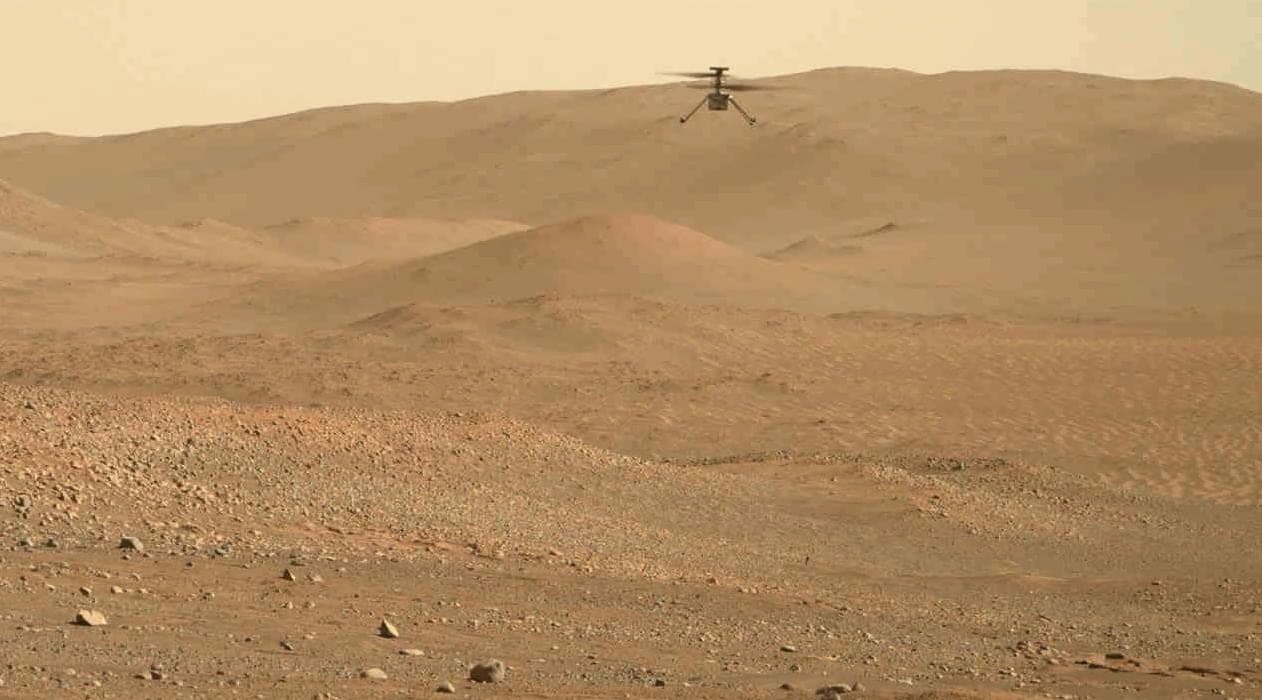
On 19 April 2021 a 1.8-kilogram machine spun its rotors up, climbed three metres, hovered for about forty seconds, and set back down. That was the whole flight. It was also the first powered, controlled flight by an aircraft anywhere other than Earth — and NASA had funded it as a technology demonstration precisely because nobody could promise the air was thick enough.
The problem is the air. Mars's surface atmosphere is roughly one percent as dense as Earth's at sea level — the equivalent of flying at about 27,000 metres, more than twice as high as any helicopter has ever reached here. A rotor in that air produces almost no lift, so Ingenuity used two counter-rotating blades spanning 1.2 metres, turning at roughly 2,400 rpm, close to ten times the speed of a terrestrial helicopter's main rotor. Everything else was built down to nothing: a solar panel the size of a paperback, a commercial smartphone processor, consumer-grade cameras and inertial sensors. NASA spent about 80 million dollars building it and 5 million flying it. The plan was five flights in thirty days, after which it would be switched off and the experiment declared over.
It flew for nearly three years instead. Seventy-two flights, 2 hours 8 minutes 48 seconds of total airtime, 17.0 kilometres covered, a maximum altitude of 24 metres and a top speed of 36 kilometres per hour. Somewhere in there it stopped being a technology demonstration and became infrastructure: Perseverance's science team started using it to photograph outcrops and scout driving routes days before the rover reached them.
Flight 72, on 18 January 2024, was supposed to be a short vertical hop to check the systems after a rough landing on the previous flight. Ingenuity navigated by pointing a camera at the ground and tracking surface features frame to frame. It was flying over a stretch of sand ripples with almost no texture — nothing distinct enough to lock onto — and its estimate of its own horizontal velocity drifted. It came down hard and sideways. Navigation images afterwards showed the shadow of a rotor blade with its tip gone. All four were damaged: three snapped about a third of the way in from the tip, and the fourth tore off at the root and was later spotted lying some fifteen metres away. Contact was reestablished the next day, and NASA declared the mission over on 25 January 2024.
It is still there, upright, on the floor of Jezero. In April 2024 engineers reprogrammed it as a stationary station that wakes each day to log temperatures and check how its solar panel and batteries are ageing. Its memory holds about twenty years of that. Perseverance will eventually drive out of radio range, and after that nobody can read any of it unless something comes back to the spot and listens.