Pathfinder bounces onto Mars and lets Sojourner out
Airbags took the shock: the lander rebounded twelve metres, bounced at least fifteen more times across Ares Vallis, then opened to release Sojourner, 10.6 kg of rover.
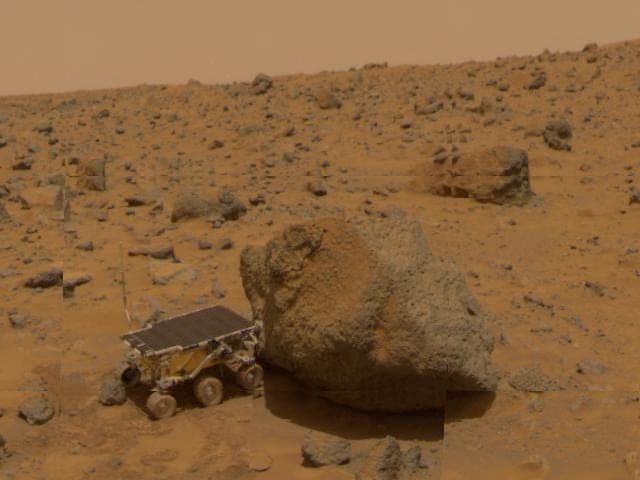
At 16:56:55 UT on 4 July 1997 a tetrahedron wrapped in twenty-four airbag lobes hit Ares Vallis at 18 metres per second — 14 straight down, 12 sideways — rebounded about twelve metres into the air, and did it again at least fifteen more times before rolling to a stop roughly a kilometre from where it first touched. Then the bags deflated, internal winches dragged them in, and three petals folded open. Nothing had worked on the surface of Mars since Viking 1 fell silent in 1982.
Pathfinder was cheap against what it replaced — about $265 million all in, versus roughly a billion 1970s dollars for Viking. It was also deliberately crude. There was no orbital reconnaissance first and no braking into orbit: the cruise stage was jettisoned and the capsule went straight into the atmosphere at 7.3 kilometres per second, deployed a parachute, dropped its heat shield, lowered the lander down a twenty-metre braided Kevlar bridle, inflated the bags in about three-tenths of a second, fired three solid retrorockets at 98 metres, and cut the bridle twenty-one metres above the ground. Every step was one-shot, with no way to test the whole chain on Earth. Bouncing had precedent — Luna 9's capsule bounced onto the Moon in 1966 — but nothing remotely like this had been tried at Mars.
Out of the lander came Sojourner: 10.6 kilograms, 65 centimetres long, six wheels on a rocker-bogie suspension, a top speed of about one centimetre per second. A signal took more than ten minutes to reach Earth and as long again to come back, so the rover was never driven live. Operators sent waypoints and hazard rules and the rover felt its way there. It carried one real instrument, an alpha proton X-ray spectrometer it pressed against rocks the team named Barnacle Bill, Yogi and Scooby-Doo. The readings suggested compositions more silica-rich than the basalts Viking had implied, hinting at a crust that had differentiated — an interpretation still argued over, because dust coatings and weathering rinds can skew the numbers.
The lander was built for 30 sols and the rover for seven. The lander returned data for 83, until contact was lost on 27 September 1997 for reasons never established. Sojourner covered about a hundred metres in total and never went more than a dozen metres from home. Meanwhile the mission's website took tens of millions of hits a day — early, unambiguous proof that people will watch a robot crawl across another planet if you let them see it.