A Martian meteorite is said to hold fossils
Bill Clinton stood in front of the cameras for a 1.9 kg rock from Antarctica. Within five years every line of evidence for Martian microbes had a non-biological answer.
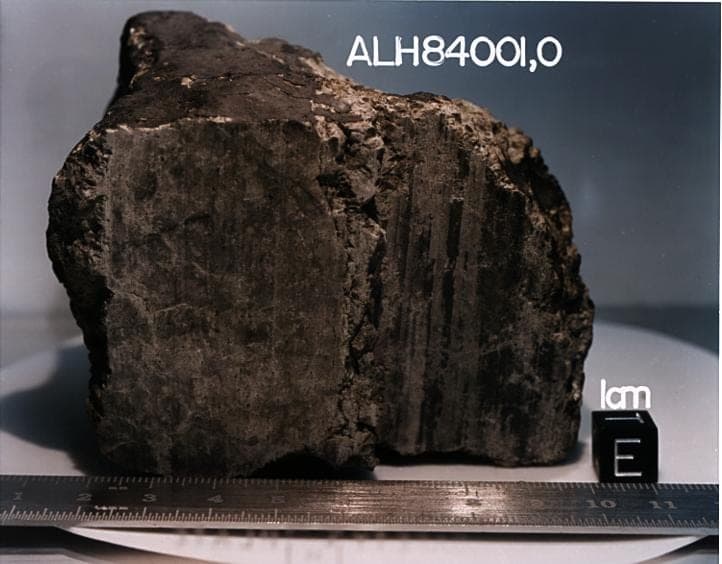
ALH84001 was picked up off the Allan Hills ice field in Antarctica on 27 December 1984: a 1.93-kilogram lump of greenish rock that then sat in a Houston curation cabinet for nine years, misfiled as an ordinary asteroid fragment. In 1993 it was reclassified. Gas trapped in its glass matched the Martian atmosphere Viking had measured in 1976. It was also extraordinarily old, crystallised roughly 4.09 billion years ago — a piece of the planet's infancy, and older by well over a billion years than any other rock we have from Mars.
On 7 August 1996 a NASA team led by David McKay at Johnson Space Center announced that four separate lines of evidence in the rock pointed, together, to past biological activity: carbonate globules of the kind microbial colonies leave behind; polycyclic aromatic hydrocarbons concentrated inside those globules; grains of magnetite and iron sulfide resembling the crystals magnetotactic bacteria manufacture; and, in electron micrographs, segmented ovoid and rod shapes 20 to 100 nanometres long that looked like very small fossils. President Clinton spoke about it from the South Lawn the same day. The paper ran in Science nine days later.
Each leg came off over the following five years. The ovoids went first — at those dimensions they were an order of magnitude smaller than any free-living cell known, with no room inside for a ribosome, and in 1997 Bradley, Harvey and McSween argued in Nature that the segmented forms were artefacts of the metal coating sputtered onto the sample to make it conduct under the electron beam. PAHs turn up in carbonaceous meteorites with no biology anywhere near them, and in Antarctic meltwater. The carbonates could be precipitated by warm fluid circulating through hot rock.
The magnetite argument held longest. Kathie Thomas-Keprta's group maintained that roughly a quarter of the crystals were chemically pure, defect-free and shaped in a truncated hexa-octahedral form that only biology produced. Peter Buseck's group at Arizona State answered in 2001 that mapping crystal shape reliably at 40 to 100 nanometres was beyond the instruments available when the claim was made, and that the shapes bacteria actually produce vary far more than the argument assumed — which makes a coincidental match easy.
The biogenic interpretation is not accepted today; most researchers favour non-biological origins for all of it. The announcement did real work anyway. It got the NASA Astrobiology Institute founded in 1998, it put a budget line and a discipline behind the question, and it forced the field to be explicit about what evidence would actually count as life in a rock. McKay defended the reading until his death in 2013.