Perseverance lands in Jezero, and we watch it happen
Five off-the-shelf cameras filmed the parachute opening and the sky crane lowering a one-tonne rover into a dry river delta. The descent microphone recorded nothing usable.
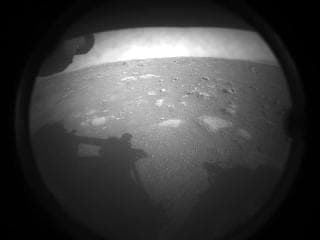
Perseverance touched down at 20:55 UTC on 18 February 2021, on the floor of Jezero crater. Light took eleven minutes to reach Earth, so the whole of entry, descent and landing — every decision, every failure mode — had already resolved itself before anyone at JPL heard the first tone. The rover weighed 1,025 kilograms, roughly a small car, and it was aiming at an ellipse 7.7 by 6.6 kilometres laid over ground cluttered with boulders, cliffs and a 400-metre-wide river channel. Earlier missions picked flat, boring ground precisely because they could not steer.
This one could. Terrain-Relative Navigation gave the descent stage a downward camera and a stored hazard map; during the parachute phase it matched what it saw against the map, worked out where it actually was, and picked a safer patch to fly to. The parachute itself was 21.5 metres across, packed into a nylon-and-Kevlar cylinder 46 by 66 centimetres and fired about 230 seconds after entry, still supersonic; it went from that cylinder to full canopy in under a second, generating tens of thousands of pounds of force. Its orange-and-white panels were not decorative: the pattern encodes "Dare Mighty Things" in binary, along with the coordinates of JPL.
Five commercial off-the-shelf cameras — two on the back shell, one on the descent stage, two on the rover — produced something nobody had ever seen. Curiosity's descent imager had returned a downward-looking video in 2012; this came back as film from five angles at once: the chute snapping open at 11 kilometres altitude, the heat shield falling away, dust blasting sideways under the descent stage's rockets, the cables paying out, wheels settling onto Martian ground. The landing site is named for the novelist Octavia E. Butler.
The sound did not work. A microphone was mounted to capture the descent and it returned no usable data — the one part of the sensory package that failed. It survived, though, and on 20 February it recorded sixty seconds on the surface: rover machinery, and about ten seconds in, a faint gust of wind. That was the first sound ever recorded on the surface of Mars. Two earlier attempts, on Mars Polar Lander and Phoenix, never got that far.
Jezero was chosen for what a spacecraft in orbit could only infer. A river once cut Neretva Vallis through the crater rim and built a fan of sediment on the floor. From the ground, Perseverance confirmed it within months, in a Science paper published in late 2021: the layered scarps really are a delta, and the boulders capping them are flood deposits, dropped by water moving fast enough to carry metre-scale rocks. Cost was about 2.7 billion dollars. Bolted to the rover's belly was a small helicopter; inside it, an oxygen machine and forty-three titanium tubes.