A Falcon 9 first stage flies back and lands upright
Less than ten minutes after lifting off with 11 satellites, a Falcon 9 first stage flew back to Cape Canaveral and landed upright, the first stage from an orbital launch to do so.
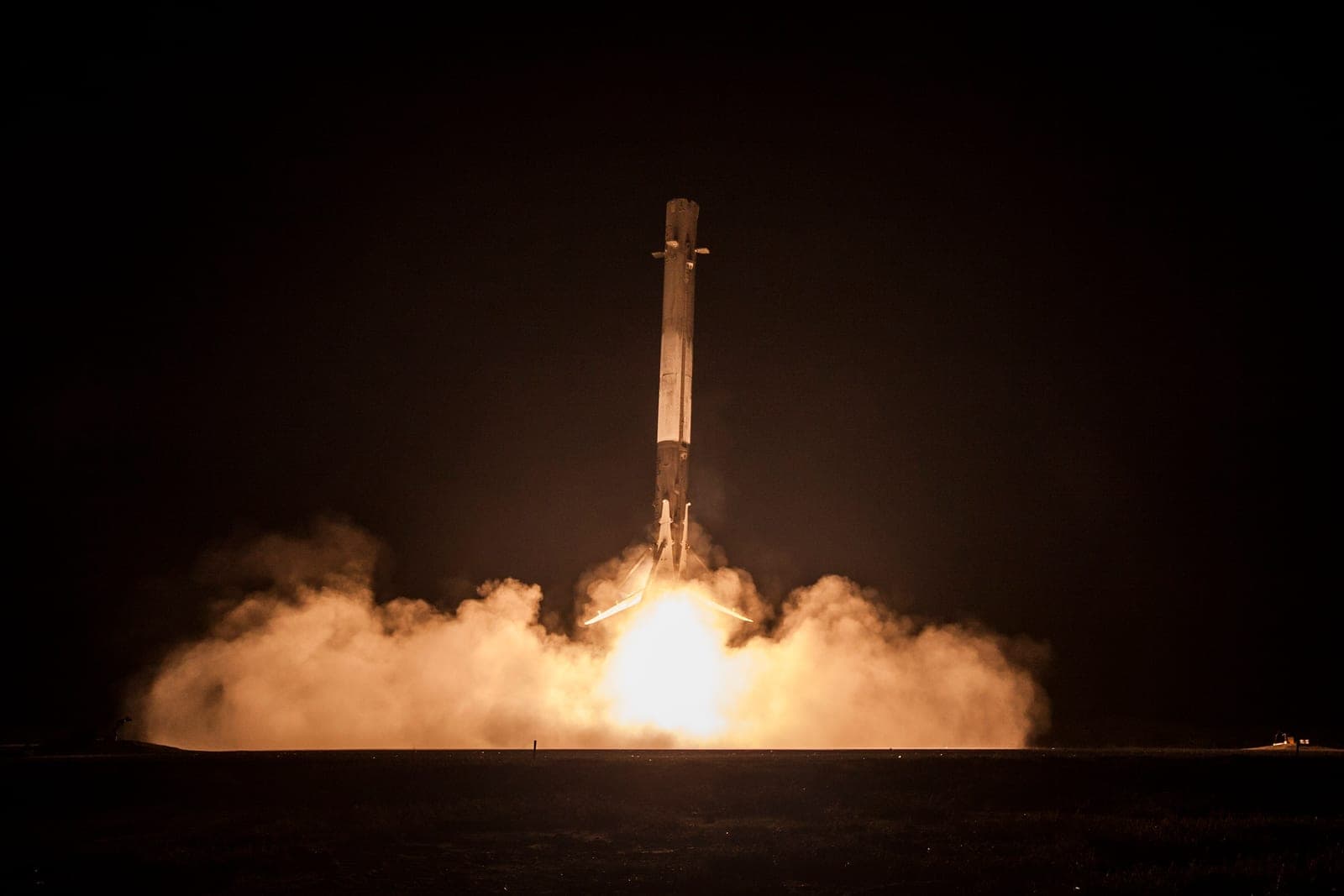
At 8:29 p.m. EST on 21 December 2015, 01:29 UTC on the 22nd, a Falcon 9 lifted off from Complex 40 at Cape Canaveral carrying 11 ORBCOMM communications satellites. About two and a half minutes into the flight the first stage, the lower and larger part of the rocket, separated, turned round and flew back. Less than ten minutes after liftoff it touched down upright on Landing Zone 1, a concrete pad built on Launch Complex 13, an old Atlas site about nine kilometres from where it had started. All 11 satellites reached a good orbit.
It was the first time a rocket stage that had helped put a payload into orbit flew back to Earth and landed upright. Blue Origin's New Shepard booster had landed on 23 November after a suborbital flight that launched no satellites; the Space Shuttle's solid rocket boosters had been recovered from the sea. SpaceX's own first stages had made controlled touchdowns in the Atlantic in 2014, and two tries in 2015 at landing on a ship at sea ended with one stage crashing into it and another tipping over.
This was also the first Falcon 9 launch in six months, and the debut of an upgraded version. On 28 June 2015 a Falcon 9 carrying cargo for the International Space Station was lost 139 seconds after launch when its second stage's liquid-oxygen tank over-pressurised; SpaceX traced the failure to a strut inside the second stage.
On the press call afterwards Elon Musk said a Falcon 9 cost about $60 million to build and its propellant about $200,000, so the potential long-term cost reduction from reuse was "probably in excess of a factor of 100". The landing, he said, "dramatically improves my confidence that a city on Mars is possible". That stage did not fly again: in August 2016 it went on permanent display outside SpaceX's headquarters in Hawthorne, California. A landed Falcon 9 first stage first flew a second time on 30 March 2017.