The streaks that turned back into sand
NASA announced briny water seeping down warm slopes. Two years later the same streaks were shown to stop exactly where dry sand stops, and the claim collapsed.
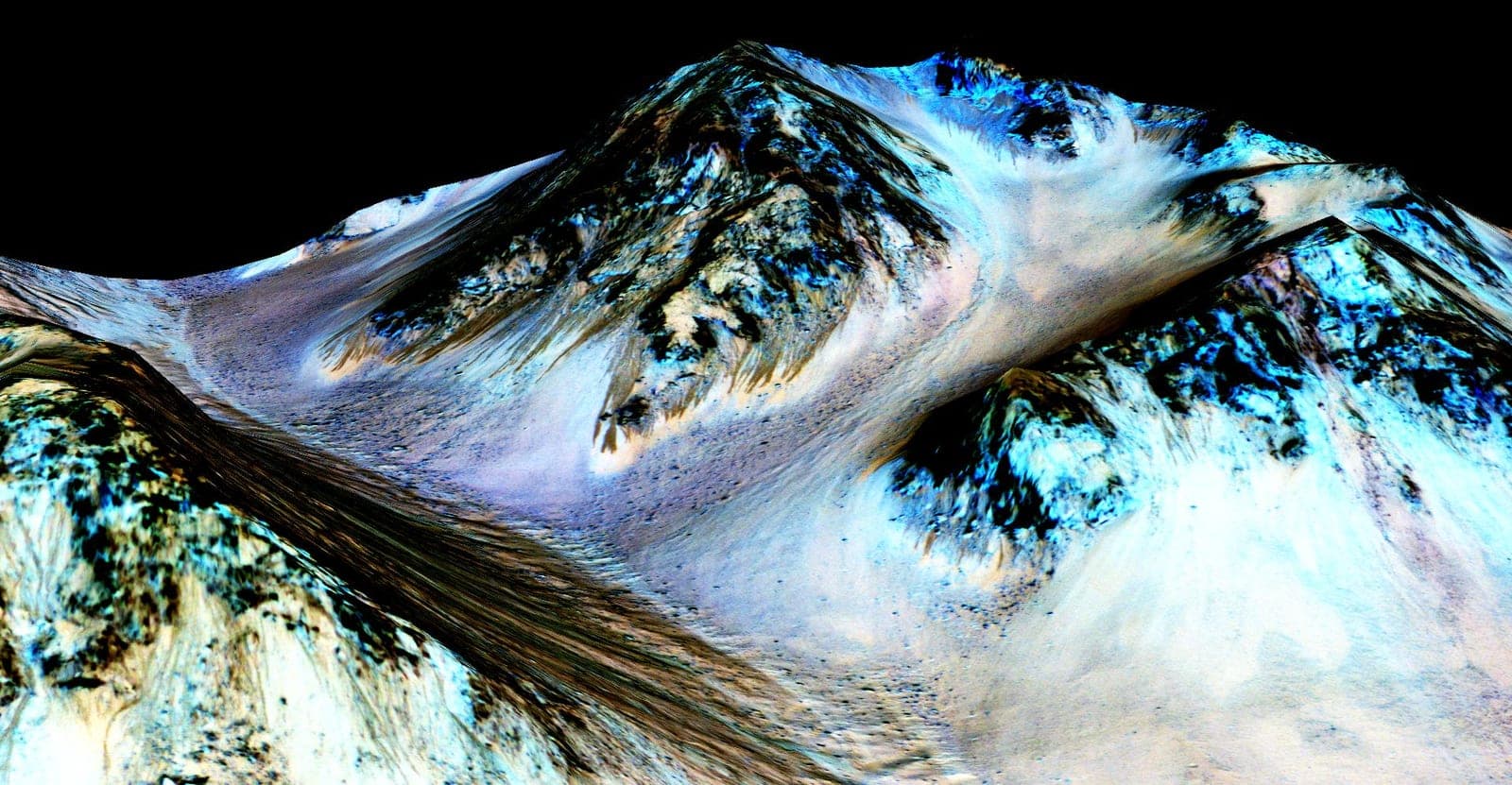
On 28 September 2015 NASA held a press conference to announce liquid water flowing on Mars today. The evidence was spectral. Lujendra Ojha, then a graduate student at Georgia Tech, had pointed the CRISM spectrometer on Mars Reconnaissance Orbiter at four sites where dark streaks creep down steep slopes in the warm season and fade as it cools. In the streaks — and only when the streaks were at their longest — the spectra showed hydrated salts: magnesium perchlorate, magnesium chlorate, sodium perchlorate. Perchlorates pull water vapour straight out of the air and hold it as brine far below the normal freezing point. The obvious reading was seeping salty water. Thin, shallow, seasonal, but liquid, and now.
The streaks themselves, recurring slope lineae, had been identified in 2011 by Alfred McEwen's HiRISE team. They are a few metres wide, they lengthen downhill over weeks, they fade, and they return the following year in the same places. The story held together well enough that RSL sites were designated candidate "special regions" under planetary protection rules, meaning no insufficiently sterilised spacecraft could be sent near them.
Then it came apart. The spectral detections had always been marginal: a CRISM pixel is about 18 metres across, wider than the features it was being asked to resolve, so the signal was drawn from mixed ground at the edge of the instrument's capability, and other groups argued the absorption features were processing artefacts. In November 2017 Colin Dundas and colleagues published stereo topography for 151 individual lineae at ten sites. Almost every one of them stopped on a slope of 27 degrees or steeper — precisely the angle at which loose dry sand stops moving. Water running downhill does not care about the angle of repose; it keeps going onto flatter ground and soaks in.
The working view now is that RSL are largely or entirely avalanches of dust and sand, perhaps initiated by small quantities of water or by gas released from the soil. The planetary protection restrictions stayed on: until the streaks are definitively characterised, anything landing near one must still be sterilised as though water were there.
The pattern repeated with the other great present-day water claim. In July 2018 Roberto Orosei's team reported a bright radar reflection from beneath the south polar ice at Ultimi Scopuli, about 1.5 kilometres down and 20 kilometres across, and read it as a subglacial lake. By 2021 other groups had shown that frozen smectite clay, or simple constructive interference between thin layers of ice and dust, reproduces the same bright reflection with no liquid anywhere. That argument is still open.
None of this touches the ancient water, which the rock record makes unambiguous. It is present-day liquid water that keeps dissolving under scrutiny — and it keeps doing so for a boring reason. Across most of the planet the surface pressure sits at or below the triple point of water, so the honest prior was always that liquid water there is very hard to keep.