Falcon 1 reaches orbit on the fourth attempt
After three failures, SpaceX's Falcon 1 put a 165 kg dummy payload into orbit from a Pacific atoll: by SpaceX's account the first privately developed liquid-fuelled rocket to get there.
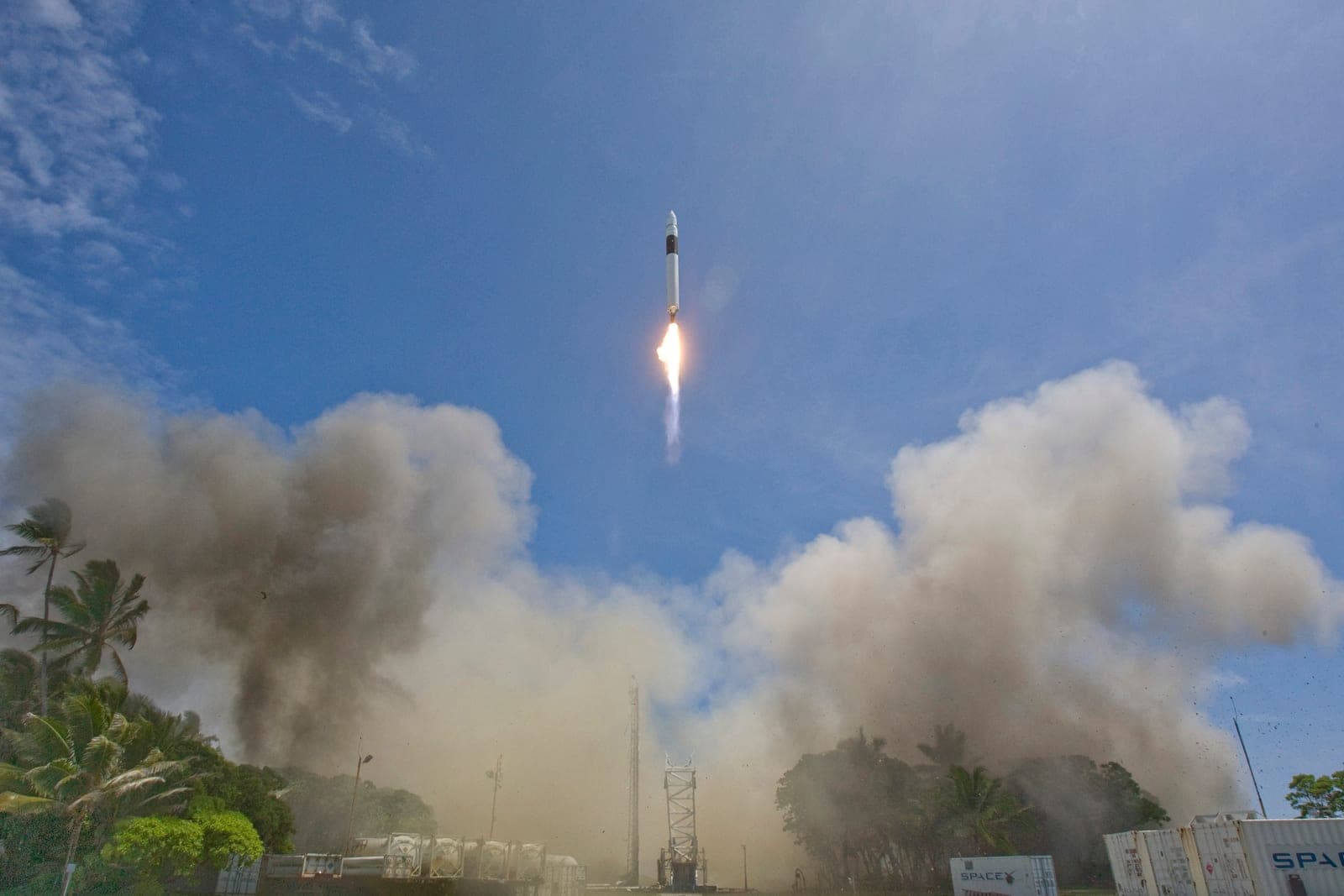
At 23:15 UTC on 28 September 2008 a two-stage Falcon 1 lifted off from Omelek Island in the Kwajalein Atoll, in the central Pacific. About nine and a half minutes later its second stage shut down in orbit. It was SpaceX's fourth attempt, and SpaceX called Falcon 1 the first privately developed liquid-fuelled rocket to orbit the Earth.
The first three flights had failed. In March 2006 an aluminium nut on a fuel-pump pressure sensor probably cracked through corrosion, and the fire that followed shut the engine down about half a minute into flight. In March 2007 the second stage's control system interacted with sloshing in its liquid-oxygen tank; the resulting oscillation drove propellant away from the engine feed, and the engine stopped early, short of orbit. In August 2008 the stages separated, but fuel left in the cooling channels of the new Merlin 1C first-stage engine burned with leftover oxygen, and the small thrust pushed the first stage back into the second. That flight carried the US military satellite Trailblazer, two small NASA payloads and cremated human remains.
For Flight 4 SpaceX lengthened the wait between first-stage shutdown and separation to five seconds. The payload, Ratsat, was a 165 kg hexagonal aluminium dummy built for the flight and attached to the second stage by design. The Kestrel second-stage engine's first burn ended at 330.5 km; after a 43.5-minute coast it restarted, and US military tracking confirmed a final orbit between 621 and 643 km up.
Elon Musk later said the fourth launch was "the last money that we had for Falcon 1". On 23 December 2008 NASA awarded SpaceX 12 cargo flights to the International Space Station, worth about $1.6 billion. Falcon 1 flew once more, in July 2009.
SpaceX says it was founded in 2002 with "the ultimate goal of enabling people to live on other planets". On launch day, NBC News reported, Musk told employees that the technology Falcon 1 pioneered could eventually bring humans to Mars.