Phoenix digs five centimetres and touches ice
Phoenix landed on rockets at 68 degrees north and scraped down to white material. It vanished in four sols — ice, not salt — and in September the lidar watched snow fall.
Phoenix came down on rockets. On 25 May 2008 it hit the top of the Martian atmosphere at about 5.6 kilometres per second, shed most of that on a heat shield, opened a parachute around 13 kilometres up, cut loose from the backshell at roughly 900 metres, and flew itself the rest of the way down on twelve pulsed hydrazine thrusters. It was the first fully propulsive landing on Mars since Viking 2 in 1976, and the only way to set down a lander upright with a working robotic arm instead of rolling it across the ground in bags. Mars Reconnaissance Orbiter photographed it descending under its parachute — the first time one spacecraft had imaged another landing on another planet.
It touched down at 68.2 degrees north, on the cracked polygonal ground of Vastitas Borealis, because Odyssey's neutron maps said the ice was there. The spacecraft was itself a resurrection: the Mars Surveyor 2001 lander, built, cancelled after the 1999 failures, stored in a clean room for seven years, then rebuilt and flown for about $420 million when Peter Smith's team at the University of Arizona won the first Mars Scout competition.
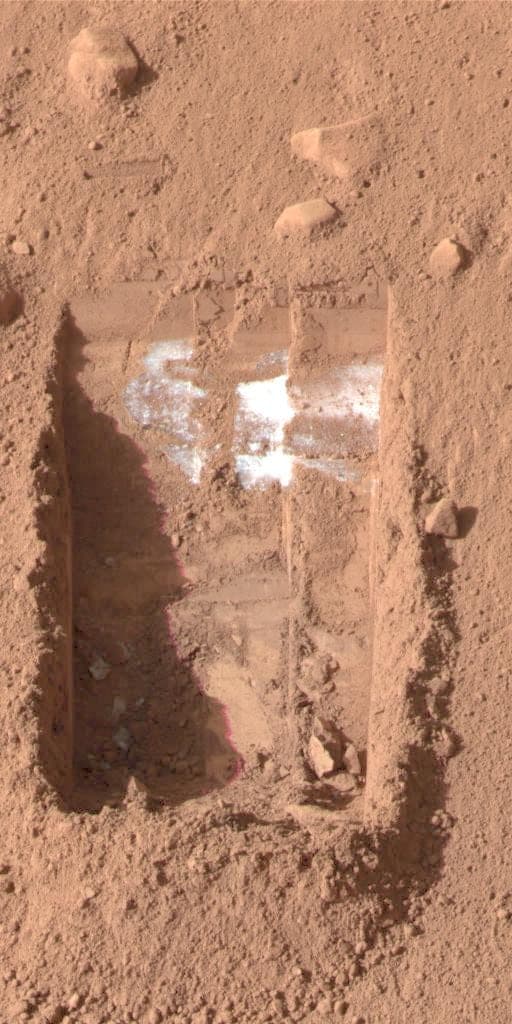
Confirmation arrived in two steps. On 15 June the arm scraped a trench the team called Dodo-Goldilocks down about five centimetres and exposed eight bright, dice-sized crumbs. Four sols later they had gone. Salt would have stayed put; water ice sublimates. Then on 30 July an oven in the Thermal and Evolved-Gas Analyzer heated a soil sample past 0 °C and the mass spectrometer saw water vapour come off it. "We have water," said William Boynton, who led the instrument — "this is the first time Martian water has been touched and tasted." Every earlier detection had been an inference from a distance.
The surprise was in the wet chemistry cells: perchlorate, at a few tenths of a percent by weight. It is a strong oxidiser, it pushes water's freezing point down toward minus 70 °C, and it wrecks organic molecules when heated — which reopened an old question about whether Viking's 1976 experiments had incinerated the very organics they were hunting for. The soil was also mildly alkaline, around pH 7.7, and held calcium carbonate. In September the lander's lidar watched snow falling out of water-ice clouds about four kilometres overhead, evaporating before it reached the ground.
Phoenix was never going to see the spring. As the arctic sun sank the power went with it. The last transmission came on 2 November 2008, sol 152, against a 90-sol design life. Images taken in 2010 showed its solar panels collapsed under a winter's worth of carbon dioxide frost.