Viking 1 and 2 land and refuse to die
Two orbiters, two landers and roughly a billion 1970s dollars. Designed for 90 days on the surface, Viking 1 kept transmitting from Chryse Planitia for over six years.
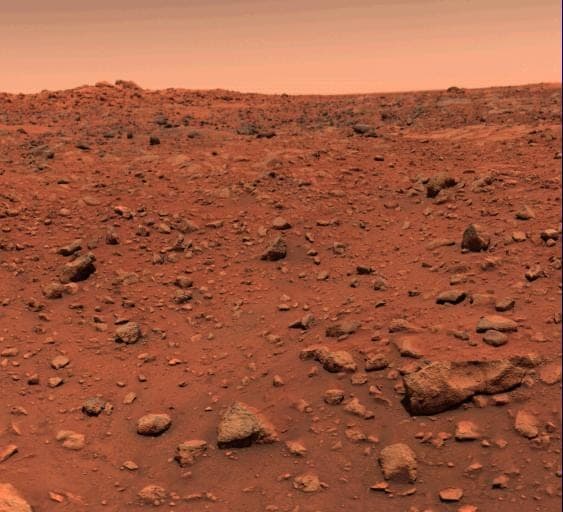
Viking 1 was supposed to land on 4 July 1976, the American bicentennial, and the date had been in the press for years. Then the orbiter arrived on 19 June and photographed the target site in Chryse Planitia, and the pictures showed a deeply incised channel bed strewn with the kind of rock that would tip a lander onto its back. The project did something that looks obvious now and was not obvious then: it stood down. Controllers spent three weeks hunting a new site from orbit, voted on 12 July for ground about 575 kilometres west, and landed there on 20 July 1976 at 11:53:06 UTC — the seventh anniversary of Apollo 11, which nobody minded. Viking 2 repeated the trick and set down in Utopia Planitia on 3 September, at nearly 48°N — far enough north that its cameras later caught frost on the ground through the winter.
Each Viking was two spacecraft: an orbiter massing 2,328 kilograms fuelled at launch, and a lander of 572 kilograms on the ground, which rode to Mars sealed inside a bioshield and heat-sterilised so that nothing from Earth could contaminate the search for life. Entry used an aeroshell, a parachute, and then three throttleable hydrazine engines, each fitted with eighteen small nozzles to spread the exhaust and avoid blasting the ground the landers were about to sample. Two radioisotope generators supplied about 70 watts. The programme cost roughly a billion dollars at the time — adjusted for inflation, still the most expensive planetary science project NASA has run.
The surface pictures arrived within minutes of touchdown and were the first anyone had: a rock-strewn plain, a horizon, a pinkish sky that the team initially processed as blue and then corrected, to some public annoyance. The landers ran meteorology stations for years. At Chryse the afternoon air reached about -33°C and predawn temperatures fell to about -86°C. They tracked dust storms sweeping in, and watched atmospheric pressure rise and fall by roughly 30 percent over the martian year as carbon dioxide froze onto the winter pole and sublimed back off it. A seismometer flew on both landers; Viking 1's never uncaged, and Viking 2's, bolted to the lander rather than coupled to the ground, recorded little beyond the wind shaking the lander.
The design life was 90 days. Viking 2's lander ran until 11 April 1980. Viking 1's last transmission reached Earth on 11 November 1982, after a faulty command from Earth cut communications; the usual account is that a new battery-charging sequence was written over the memory holding the antenna-pointing parameters, leaving the dish aimed at nothing. Controllers kept calling for another six months before giving up. Viking 1 had been on Mars for more than six years. The two landers carry names now: the Thomas Mutch Memorial Station in Chryse and the Gerald Soffen Memorial Station in Utopia, after the project's lander imaging lead and its project scientist. Both are still sitting there.