A mesa in Cydonia looks like a face
Viking 1 orbiter frame 35A72 caught a mesa a kilometre and a half across under a low sun. The shadows read as eyes, nose and mouth, and the argument ran for 25 years.
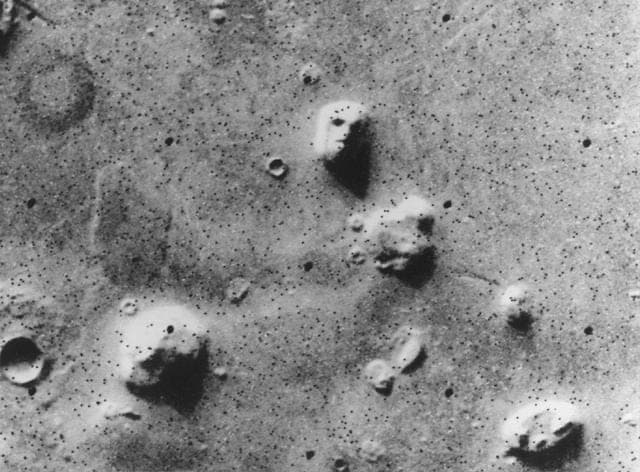
The Viking 1 orbiter was scouting landing sites for Viking 2 when it took frame 35A72 over the Cydonia region on 25 July 1976. In it, a mesa about a kilometre and a half across near 40.8°N, 9.6°W appeared to have two eyes, a nose and a mouth, staring straight up out of the plain. The frame was shot from a range of 1,873 kilometres with the sun roughly 20 degrees above the horizon, at about 43 metres per pixel, and the bit errors that speckled the transmission had dropped a black fleck exactly where a nostril would go.
NASA released the picture within days with a caption pointing out the illusion, partly because it was genuinely funny and partly because it was a good way to get people to look at Mars pictures. Viking project scientist Gerald Soffen dismissed it as a trick of light and shadow, and he was right, and that settled nothing at all. In 1980 two computer engineers, Vincent DiPietro and Gregory Molenaar, dug the original data out of the archive and reprocessed it, arguing the symmetry was too good for chance. Richard Hoagland built an entire career on the claim that Cydonia held the ruins of a civilisation, complete with pyramids and a city. By the late 1980s the Face was on book covers, in films, and in a steady stream of letters to NASA.
It took better cameras to end it. On 5 April 1998 the Mars Orbiter Camera aboard Mars Global Surveyor was turned to Cydonia and returned an image at 4.3 metres per pixel, ten times Viking's resolution. The eyes and mouth were not there. On 8 April 2001 MGS got a second, better-lit pass at about 2 metres per pixel, and Mars Express added stereo coverage and a digital elevation model in 2006. What the mesa is, in three dimensions, is an eroded knob of layered rock, one of many in Cydonia, with no more symmetry than the ones nobody ever photographed.
The Face is worth keeping on a Mars timeline anyway, and not as a joke. It is the clearest case on record of the thing that had already happened twice to Mars — Schiaparelli's canali becoming Lowell's canals, seasonal darkening becoming vegetation. Give the human visual system a noisy, low-resolution image of a real place and it will supply structure that is not in the data. Viking had just finished proving that Mars was a real place with rocks and weather and no detectable life, and the single image from the mission that most people can still picture is the one that was wrong.