Mars Sample Return runs out of money
Ten sealed tubes have lain in the dust at Three Forks since January 2023, waiting for a retrieval mission that Congress declined to fund three years later.
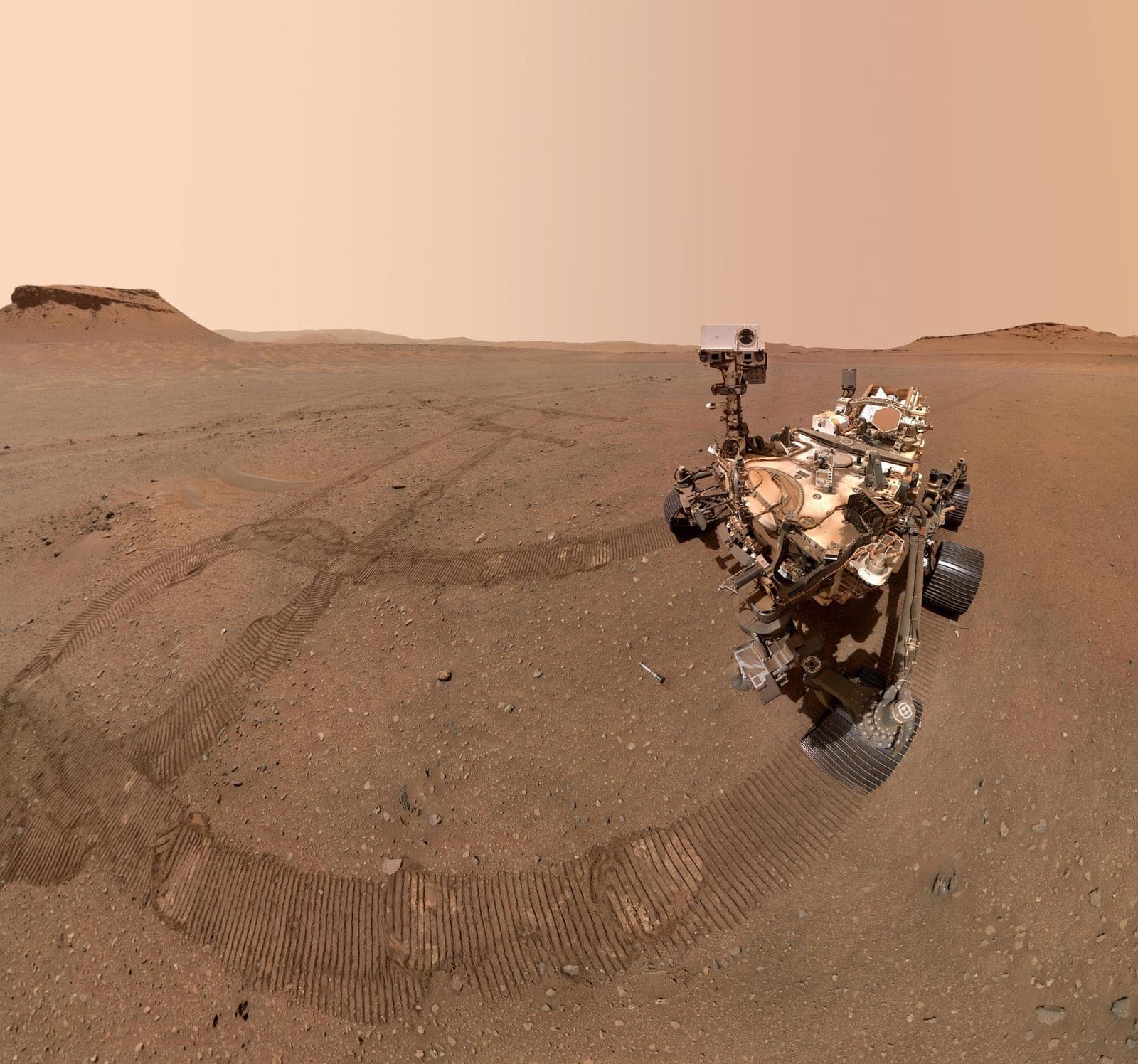
Between 21 December 2022 and 28 January 2023, Perseverance drove a slow zigzag across a flat patch of Jezero crater called Three Forks and laid ten sealed titanium tubes on the ground, five to fifteen metres apart, each mapped precisely enough to be found again under dust. They were the backup half of a paired collection; the primary set stayed aboard the rover. The plan they insured involved a NASA lander, a small rocket called the Mars Ascent Vehicle, and a European Earth Return Orbiter to catch the canister in Mars orbit and carry it home.
That plan was in trouble before the tubes hit the dirt. An independent review board chaired by Orlando Figueroa reported in September 2023 that the programme could cost as much as 11 billion dollars, against a plan built around seven, and that no samples would reach Earth before 2040 rather than 2033. It found the architecture over-constrained, the management tangled, and the published 2027 and 2028 launch dates near-impossible: the budget and schedule expectations had been unrealistic from the beginning.
In April 2024 Administrator Bill Nelson stopped the work and asked NASA centres and industry for cheaper designs. In January 2025 it narrowed the field to two: an enlarged sky crane, about twenty percent bigger than Perseverance's, at 6.6 to 7.7 billion dollars, or a commercially built heavy lander at 5.8 to 7.1 billion. Both aimed at samples on Earth in 2035–2039, and NASA said it would confirm the design in the second half of 2026.
It never got there. The White House's fiscal 2026 budget request, released in May 2025, proposed cancelling Mars Sample Return outright as financially unstable, arguing that human missions would eventually do the job. Congress rejected most of the administration's cuts to NASA and agreed with it on this one. The appropriations agreement released in early January 2026 stated that it does not support the existing Mars Sample Return programme; the House passed the package on 8 January and it was signed into law on 23 January, leaving about $110 million in a generic "Mars future missions" line and nothing for retrieval. NASA closed the Mars Sample Return Program Office. ESA, which held a €491 million contract with Airbus for the Earth Return Orbiter, spent a year hunting for another use for it: a November 2025 proposal to its ministerial council in Bremen would have converted it into an atmospheric and relay mission launching around 2032, but in March 2026 member states asked instead for outright cancellation, the electric propulsion being the likeliest salvage.
Perseverance has kept drilling regardless. Thirty of its thirty-eight sample tubes are now filled and sealed. Its plutonium power source will fade over the next decade or so, which sets a genuine deadline: a lander arriving while the rover can still drive can simply be handed the tubes, and after that someone has to collect them off the ground at Three Forks. As of September 2026 there is no funded mission to do either.