Mariner 6 and 7 find more craters
Two flybys returned 201 pictures and pinned the atmosphere at 6 to 7 millibars, but both happened to cross the oldest, dullest terrain on Mars.
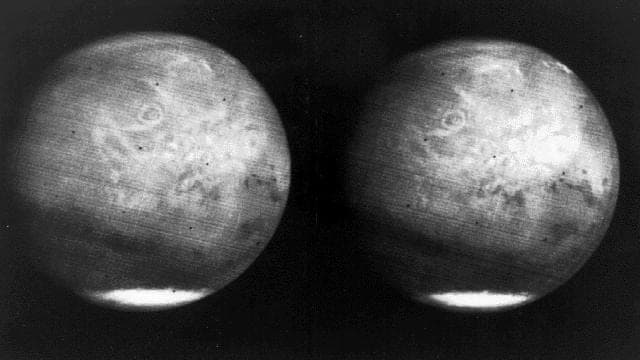
Mariner 6 passed 3,431 kilometres above Mars at 05:19:07 UT on 31 July 1969, ten days after Neil Armstrong stepped onto the Moon. Almost nobody noticed. The two spacecraft — Mariner 6 launched 25 February 1969, Mariner 7 on 27 March — carried far better cameras than Mariner 4 plus infrared and ultraviolet spectrometers. Between them they returned 201 images — 49 far-encounter and 26 close-up frames from Mariner 6, 93 and 33 from Mariner 7 — and about 800 million bits of data, against the 5.2 million bits Mariner 4 had managed four years earlier.
Mariner 7 nearly did not get there. On 30 July, with the encounter days away, the tracking station at Johannesburg lost the signal from its high-gain antenna. The spacecraft had been knocked out of alignment, most likely by a rupturing onboard battery, though a micrometeoroid strike was never ruled out. Controllers got it back on the low-gain antenna and then onto the high-gain again, but fifteen telemetry channels were gone for good. They also used the extra days to reprogram it, swinging more of its close-up sequence over the south polar cap because of what Mariner 6 had just seen there. Closest approach came on 5 August at about 3,430 kilometres.
The science was solid and largely confirmatory. The infrared spectrometer showed the south polar cap was mostly frozen carbon dioxide rather than water ice — dry ice, at around -125°C. Radio occultation put surface pressure between 6 and 7 millibars, consistent with Mariner 4. Hellas, an enormous bright circular feature, came out almost blank: no craters, no detail, nothing the geologists could work with. The best guess at the time was a dust-filled basin, which turned out to be close to right.
What the pair really demonstrated was the limit of the method. Two hundred frames snatched on the way past, from two trajectories that happened to cross the same old ground as Mariner 4, were enough to produce a confident verdict — a dead, cratered, Moon-like world with a trace of atmosphere — and the verdict was wrong. It held for just over two more years, until something arrived that could stay and look.