Mariner 4 photographs a cratered, near-airless Mars
Twenty-one grainy frames replaced the canals with craters, and a radio occultation put the surface pressure near one percent of Earth's.
Three weeks before Mariner 4 left the pad, its twin was already dead. Mariner 3 launched on 5 November 1964 with a payload shroud whose inner fibreglass layer had delaminated from the outer skin, which meant the shroud would not jettison. The spacecraft carried that dead weight, never reached a proper trans-Mars trajectory, and drained its battery before the solar panels could open. JPL redesigned the shroud and got Mariner 4 off the pad on 28 November, near the end of the window.
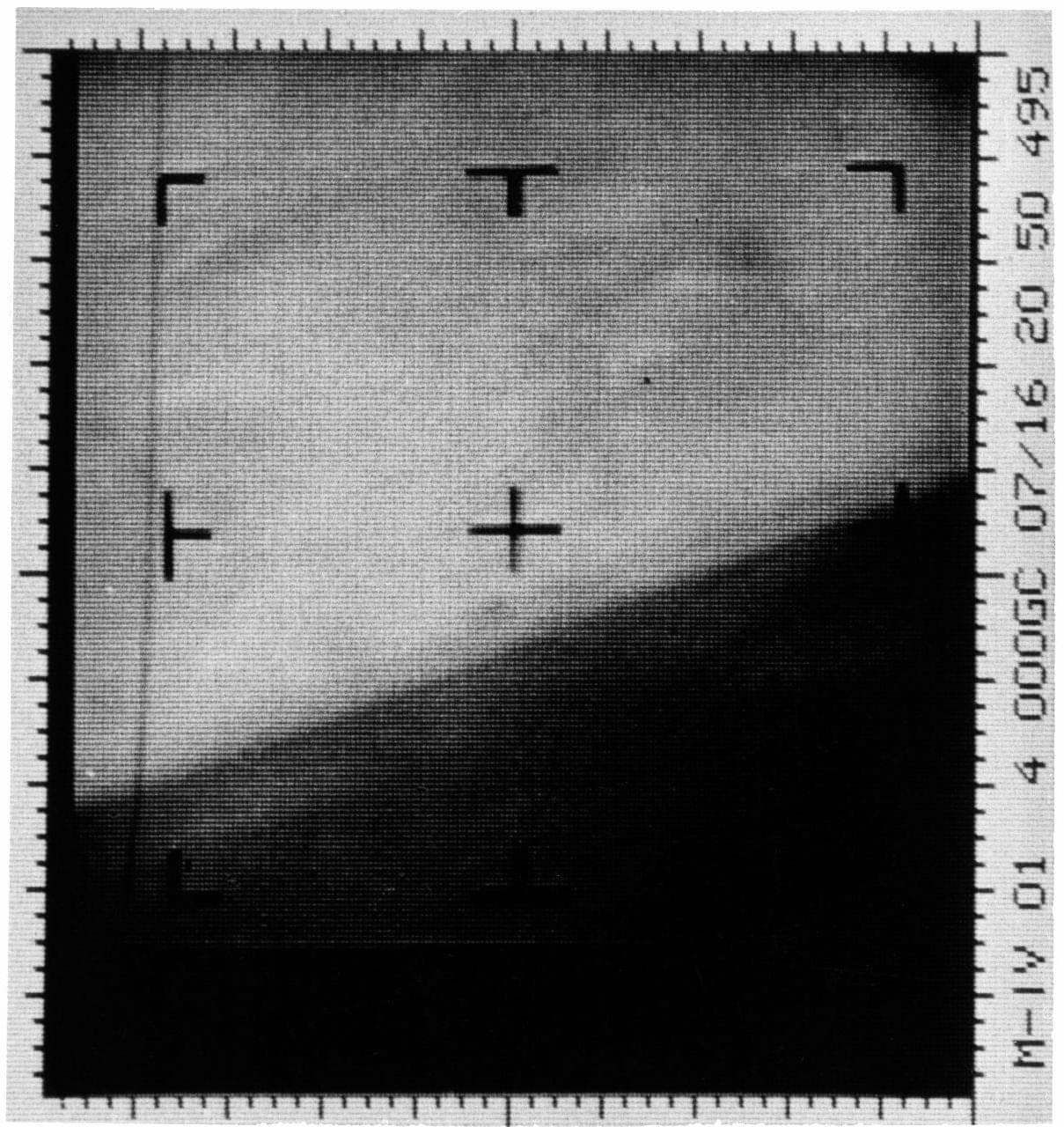
Closest approach came at 01:00:57 UT on 15 July 1965, at 9,846 kilometres above the surface. The camera took 21 complete pictures plus 21 lines of a twenty-second one, each frame 200 by 200 pixels with six bits of grey per pixel. The radio link ran at eight and a third bits per second, so a single 240,000-bit frame needed about eight hours of transmission time. The whole mission returned 5.2 million bits — less than a modern phone photo. Too impatient to wait for the official processing, engineers in JPL's telecommunications section tore off the printed strips of raw numbers, pinned them side by side on a display panel, and coloured them in by hand with pastels bought from a nearby art shop.
The pictures showed craters. Not canals, not oases, not the seasonal darkening that generations of observers had read as vegetation — just a battered, Moon-like surface. The blow landed harder because of the radio occultation experiment, which watched the signal bend as the spacecraft passed behind the planet. It gave a surface pressure of 4.1 to 7.0 millibars, roughly one percent of Earth's at sea level, with daytime temperatures near -100°C. At that pressure liquid water cannot exist on the surface. Mariner 4 also found no magnetic field and no trapped radiation belts, so the atmosphere and ground lie open to solar and cosmic radiation.
Percival Lowell's Mars died that week, and the public mood swung hard the other way: Mars was a corpse, geologically dull, not worth the trouble. That reading was almost as wrong as the canals had been. Mariner 4 imaged about one percent of the planet, and by bad luck it flew over the ancient, heavily cratered southern highlands — the oldest and least eventful ground on Mars, with Tharsis and Valles Marineris outside the frame entirely. It would take another six years and a spacecraft in orbit to find out what had been missed.