Gale Crater held a lake you could have drunk from
Curiosity's first drill hole, 6.4 cm into a mudstone called John Klein, produced clay, sulfur and nitrogen — and an ancient lake of fresh, neutral water.
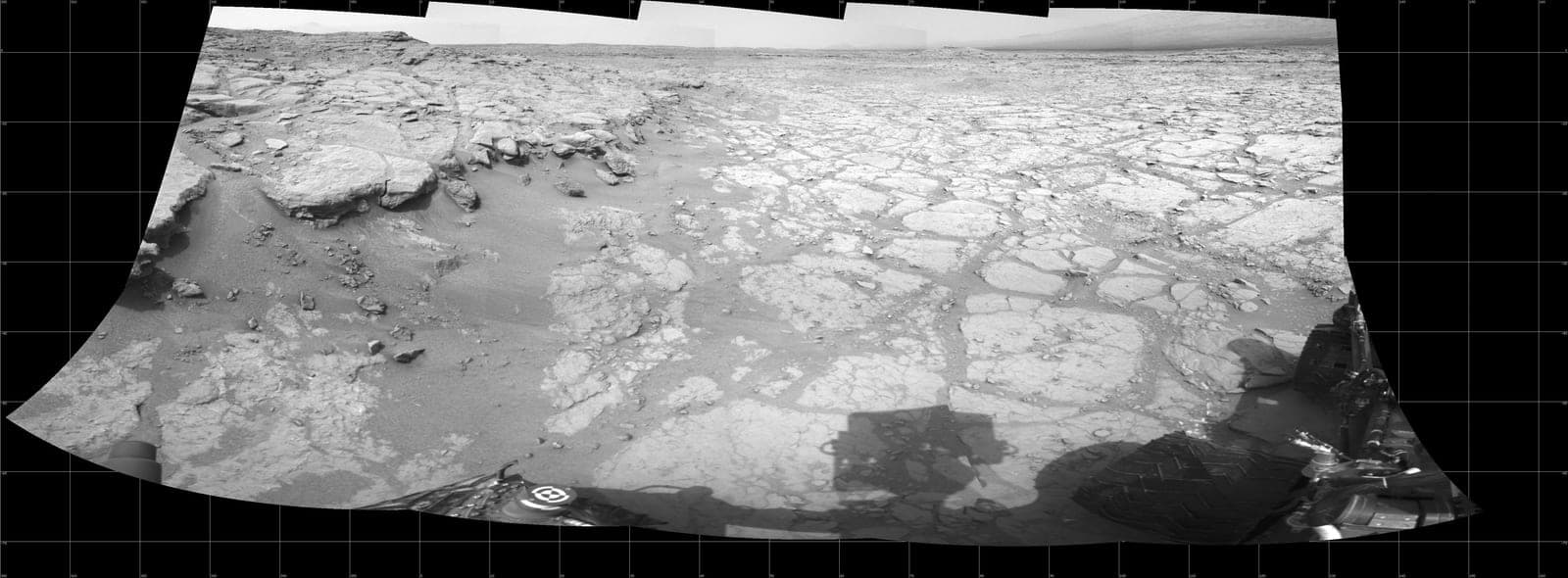
Curiosity drilled into Mars for the first time on 8 February 2013, sol 182 of the mission, into a flat slab of pale mudstone the team had named John Klein after a deputy project manager who had died two years earlier. The hole was 1.6 centimetres across and 6.4 centimetres deep. The powder that came out was grey, not red. The iron in it had never been thoroughly oxidised.
On 12 March 2013 NASA announced what was in the powder. The CheMin X-ray diffractometer found smectite clay, which forms in water that is not acidic. The SAM instrument suite found sulfur, nitrogen, hydrogen, oxygen, phosphorus and carbon, and found sulfur present in both oxidised and reduced forms — a chemical gradient of the kind terrestrial microbes make a living from. Calcium sulfate veins ran through the rock, so water had moved through it after the mud was laid down. Taken together the sample described fresh water: near-neutral pH, low salinity, not harshly oxidising. John Grotzinger, the project scientist, told the press conference that if that water had been around and you had been standing on the planet, you would have been able to drink it.
That was the answer to the question Curiosity had been sent to ask. Mars had once been habitable. Not inhabited — no fossils, no life, and at that point not even organic molecules — but a place where life as we understand it could have made a living, documented in a rock a rover had physically ground into powder.
The follow-up work put numbers on it. In January 2014 Ken Farley's team reported the first radiometric age ever measured on the surface of another planet, using potassium-argon on the Cumberland sample from the same mudstone: 4.21 billion years, give or take 0.35. That is the age of the rock the grains had eroded from, not of the lake — a ceiling on the mudstone rather than a birthday for it. A companion measurement of cosmic-ray exposure showed the rock had been shielded from radiation until roughly 78 million years ago, which is both why organic molecules might survive in it and a practical instruction to future missions — drill where erosion has recently stripped the surface. The sedimentology piled up alongside. Gale had not held a puddle. Rivers ran into a lake that filled, dried and refilled, over a stretch later argued to run from thousands to millions of years.
The wording mattered, and the mission was disciplined about it. Habitable is not inhabited. But after Mariner 9's dry channels, Viking's ambiguous soil and Opportunity's acidic brines, Yellowknife Bay was the first martian environment anyone could describe in the same ordinary language as an Earth lake bed. The question stopped being whether Mars ever had water. It became how long the water stayed, and whether anything had time to use it.