Curiosity survives the seven minutes of terror
A rocket-powered crane lowered an 899-kilogram rover onto the floor of Gale Crater on cables. The system had never been flown, and it worked first time.
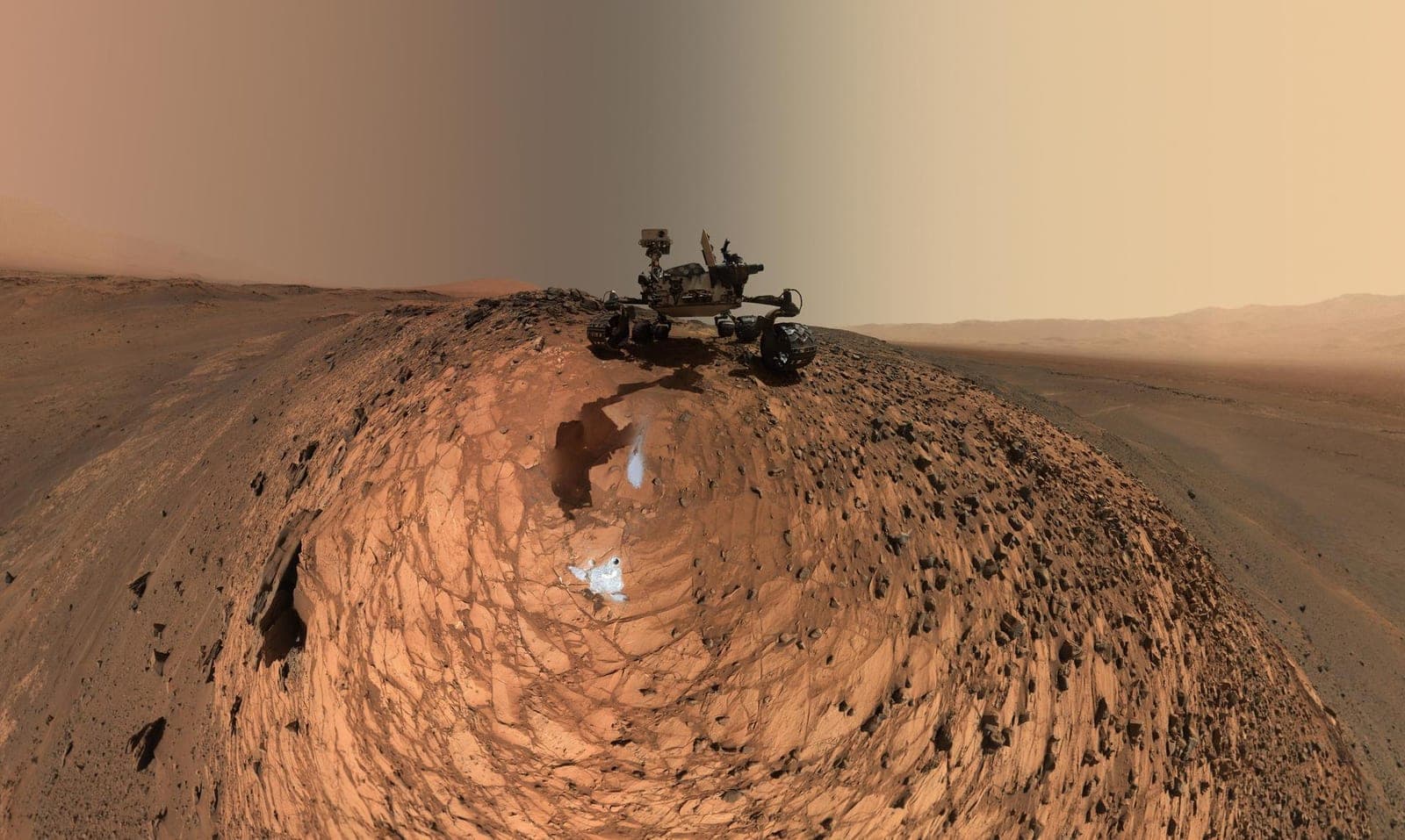
Touchdown came at 05:17:57 UTC on 6 August 2012. Nobody in the control room at JPL knew it for another thirteen minutes and forty-eight seconds, because that was the one-way light time to Mars that night. By the time the first bit of news arrived, the rover had either been sitting in Gale Crater for a quarter of an hour or scattered across it for the same length of time. Nothing anyone on Earth could do would change which.
The problem was mass. Curiosity weighs 899 kilograms, roughly five times Spirit or Opportunity, and no airbag system could survive dropping it. So JPL invented a new way down. The capsule hit the atmosphere at about 5.8 kilometres per second behind the largest heat shield ever flown to another planet — 4.5 metres across — and flew a steered, lifting entry, shedding tungsten ballast to shift its centre of mass and aim itself. A supersonic parachute nearly 16 metres across opened eleven kilometres up, at about 405 metres per second. The heat shield dropped away. Then the back shell and parachute were cut loose and a descent stage with eight throttleable engines took over, flew clear of the falling debris, slowed to walking pace about twenty metres up, and winched the rover out from underneath itself on nylon cables. When the wheels took the load, pyrotechnic blades severed the cables and the descent stage flew off to crash at a safe distance.
The sky crane had never been flown, and it could not be tested end to end on Earth, where both the air and the gravity are wrong. The sequence ran itself through some seventy-six pyrotechnic devices in about seven minutes with no possibility of intervention. JPL's own animation called it the seven minutes of terror, and the name stuck. Even hearing about it depended on a piece of housekeeping: two weeks earlier, a six-second thruster burn had nudged the 2001 Mars Odyssey orbiter six minutes ahead in its orbit so it would be overhead to relay the landing telemetry in real time.
It worked. Curiosity stopped 2.4 kilometres from the centre of its target, on Aeolis Palus at 4.6 degrees south, in a 154-kilometre crater chosen for the mountain in the middle of it — Aeolis Mons, informally Mount Sharp, about five kilometres of layered sediment stacked like a book of martian climate history. The rover's brief was not to find life. It was to find out whether this place could ever have supported it, a deliberately narrower question than the one Viking had asked and failed to close.
Fourteen years later Curiosity is still driving; in August 2026 it passed a full kilometre of vertical climb up Mount Sharp. And the sky crane stopped being exotic. Perseverance used the same architecture in February 2021, with terrain-relative navigation added on top.