Babylon turns Mars into arithmetic
Babylonian scribes logged Mars beside barley prices for six centuries, then used a 79-year repeat to predict where it would be — with no model of why.
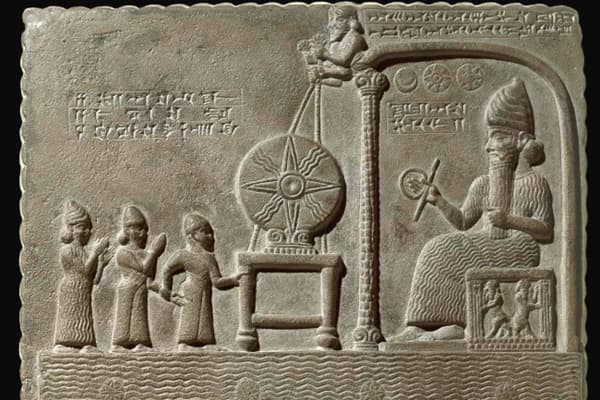
The oldest surviving Astronomical Diary covers the year 652/651 BCE, and the format barely moved for six centuries. On one tablet a scribe logs the Moon's position night by night, the planets, eclipses, solstices and equinoxes, the level of the Euphrates, the going rate for barley, dates, mustard, sesame and wool, and what the king had been doing. Mars is there under two names: Ṣalbatānu, the workaday planet-word, and Nergal, god of plague, war and the underworld. The diaries kept coming — six months to a tablet — until 61/60 BCE. It is probably the longest observing programme ever run.
The purpose was omens, not astronomy. The by-product was the first long quantitative record of the sky in human history, and it was long enough to expose the patterns. Mars's first appearances, last appearances and stations repeat after 79 years — 36.995 synodic cycles, close enough that the calendar dates come back almost unchanged. Its passes by the reference stars repeat after 47 years, or 22.01 cycles. A 47-year Mars period is already named on a tablet possibly written in the second half of the seventh century BCE.
Out of that came the Goal-Year Texts, and they are the genuinely startling part. To forecast Mars for a coming year, a scribe pulled its record from 79 years earlier, applied a standing correction of about three days, and copied the result forward. No orbit, no geometry, no cause. Prediction by long memory and addition. It worked, and it worked for centuries, and nothing in it required anyone to have a theory of what Mars was.
The limits were real and they were worst for Mars. The interval between successive conjunctions of Mars with the Sun is not fixed: it runs from roughly 765 to roughly 805 days around a 780-day average, so a mean period alone forecasts badly. Mars ended up carrying two Goal-Year numbers where Saturn got by with one, and it is not clear why: modern analysis of the date corrections finds that the 79-year period would have served perfectly well for the star passages too. What the scribes never did was ask why the cycles existed at all. Nergal's anger and a 79-year repeat sat on the same tablet without anyone appearing to feel a contradiction.
The material did not stay in Mesopotamia. Aristotle notes that the Egyptians and Babylonians had kept star observations for very many years and that much of what the Greeks knew came from them; Hipparchus and Ptolemy worked directly from Babylonian observations and periods. Most of the tablets now sit in the British Museum, a great many of them still unpublished. The arithmetic that would eventually be pointed at Mars was invented by people who thought they were reading a god's intentions.