Tycho Brahe builds Uraniborg and measures Mars by eye
Tycho fixed Mars to about an arcminute with sighting instruments alone, cross-checking with duplicate observers and correcting for refraction — and the logbooks went to Kepler.
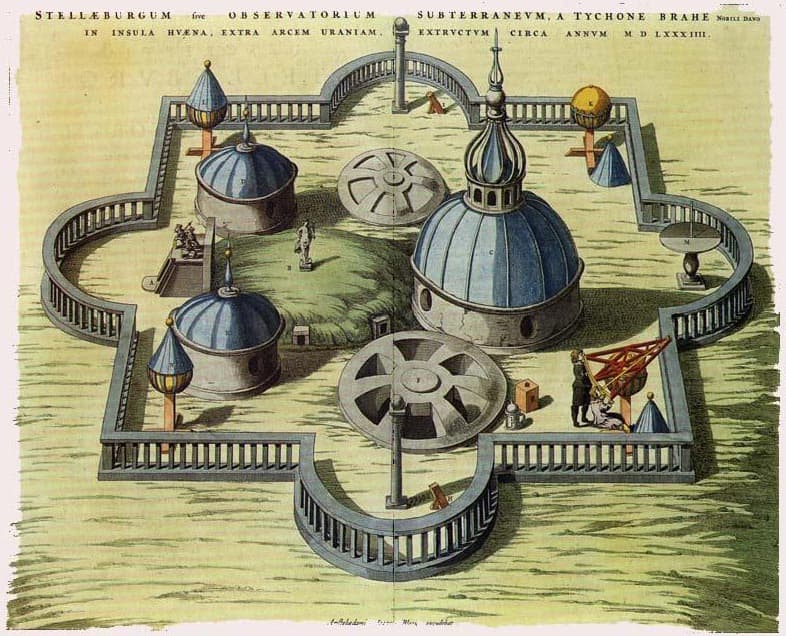
On 23 May 1576, Frederick II of Denmark handed a 29-year-old nobleman an island. Hven sat in the Øresund between Zealand and Scania, about three kilometres across, and came with an annual stipend. Tycho Brahe spent it on Uraniborg — part observatory, part alchemical laboratory, part Renaissance palace with a formal garden and a printing press. When he found that wind shook his instruments on the upper floors, he dug a second observatory, Stjerneborg, into the ground beside it and put the instruments in pits.
What came out of Hven over the next twenty years was the last and best body of naked-eye astronomy ever produced. Tycho's quadrants and armillary spheres were enormous on purpose: the larger the arc, the finer the divisions you can engrave and read. His best instruments held stellar and planetary positions to roughly an arcminute, a sixtieth of a degree. He also did something rarer than precision — he cross-checked, running duplicate instruments and separate observers on the same object, and he corrected for atmospheric refraction, which almost nobody else bothered with.
Mars got particular attention, because Mars was the problem child. Its orbit is the most eccentric of the planets that a pre-telescopic observer could follow well, and its predicted position was persistently, embarrassingly wrong in every existing table. Tycho logged it opposition after opposition, year after year, accumulating a record of Martian positions that existed nowhere else on Earth.
His own cosmology did not survive him. The Tychonic system had the five planets circling the Sun while the Sun and Moon circled a stationary Earth — a compromise that bought the geometry of Copernicus without conceding that the ground moves. It is a historical curiosity now. He was also wrong about the comet of 1577 in some details, though right about the thing that mattered: it moved through the region where the crystalline spheres were supposed to be, and so there were no spheres.
The measurements outlived the theory, which is the whole point. Tycho fell out with Denmark's new king, left Hven in 1597, and died in Prague in 1601. After an ugly scramble with his heirs, the Mars logbooks passed to his assistant — a short-sighted, quarrelsome German mathematician named Johannes Kepler, who had been given the planet as a work assignment. Tycho had spent a fortune building a trap that no circular orbit could escape. Kepler walked into it.