Spirit and Opportunity find the chemistry of water
Built for 90 sols apiece, Spirit lasted six years and Opportunity fourteen. Within eight weeks Opportunity had jarosite and hematite spherules: rock soaked in acidic water.
Opportunity bounced into a twenty-two-metre crater. Nobody planned that. The airbags dropped it into what the team named Eagle Crater on 25 January 2004 UTC, and it rolled to a stop a few metres from a wall of exposed bedrock — the first outcrop any Mars mission had been able to drive up to and touch. Steve Squyres called it a hole in one, and functionally it was: everything the mission had been sent to find was sitting in that one wall.
Spirit had landed three weeks earlier, on 4 January UTC, in Gusev Crater — chosen because a vast channel drains into it and the floor ought to have been an old lake bed. It was basalt. Spirit spent most of its first year crossing dull volcanic plains to reach the Columbia Hills, and only there started turning up altered, hydrated rock.
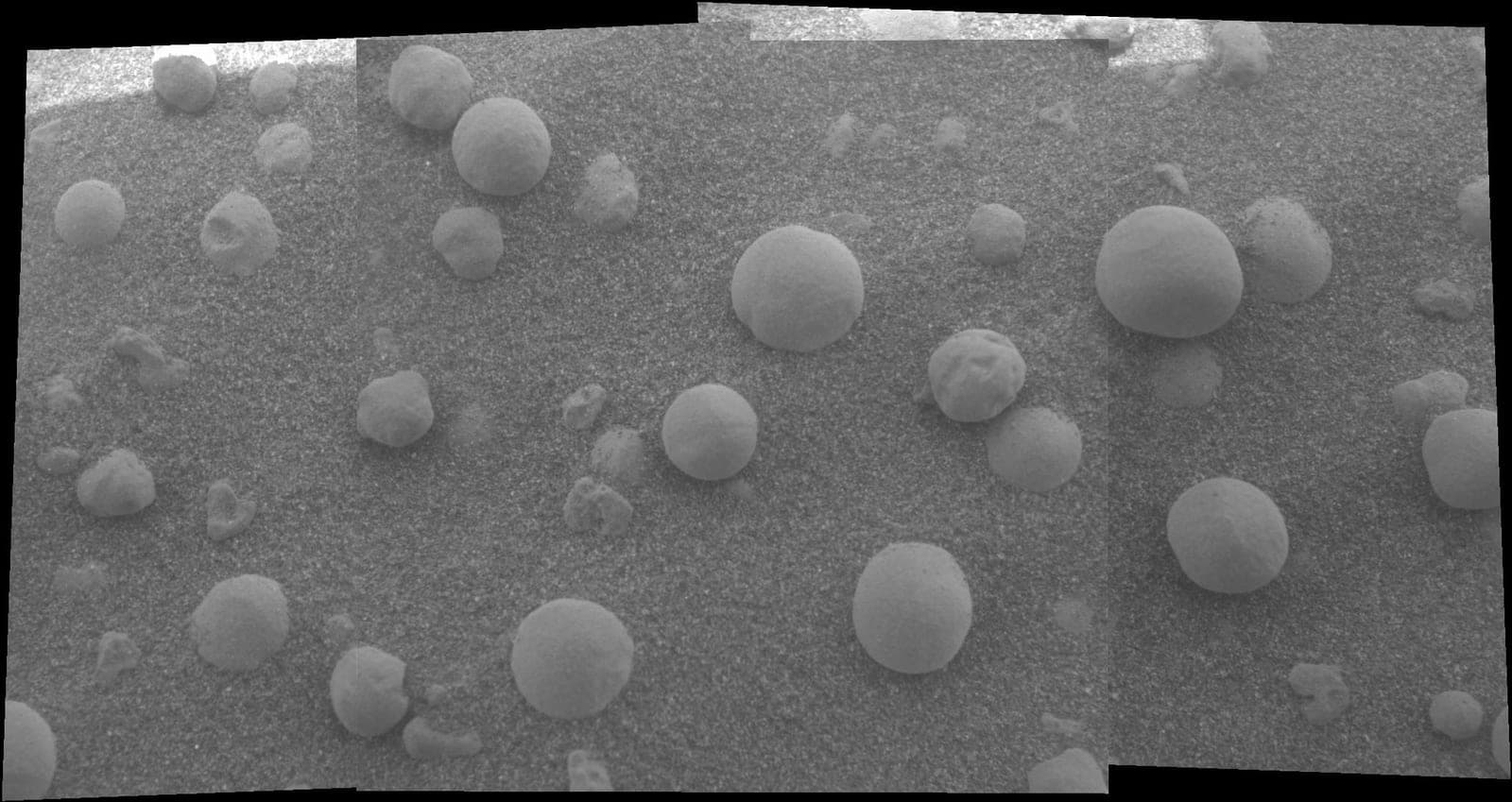
At the outcrop Opportunity named El Capitan, the Mössbauer spectrometer identified jarosite, a hydrated iron sulfate that forms only in acidic, sulfur-rich water. The microscopic imager showed millimetre-scale hematite spheres — "blueberries" — weathering out of the rock face and scattered across the ground below it. The rock was cross-bedded in curving festoon shapes that form under flowing water, and riddled with voids where crystals had dissolved out. NASA announced it on 2 March 2004; the full papers ran in Science that December. Meridiani Planum had been repeatedly flooded, evaporated and dried — habitable in principle, though water that acidic would have been a hard place to live.
Spirit's best result came by accident. Its right front wheel seized in 2006 and it drove backwards for years afterwards, dragging the dead wheel like a plough. In 2007 that furrow turned up almost pure silica: the signature of a hot spring or a fumarole, which on Earth is exactly where life crowds in.
Both rovers were built for 90 sols and about 600 metres of driving. Spirit managed 7.73 kilometres over six years, broke through a crust into soft sulfate-rich sand at a spot called Troy on 1 May 2009, could not tilt its panels toward the winter sun, and stopped transmitting on 22 March 2010; NASA gave up listening on 25 May 2011. Opportunity drove 45.16 kilometres — further than a marathon — worked for fourteen years and four months, reached the rim of Endeavour Crater where it found clays and gypsum veins laid down by neutral water, and was finally put out by a planet-wide dust storm in June 2018. Neither would have lasted anything like as long without the gusts and dust devils that kept wandering across their solar panels and sweeping them clean — an effect nobody had counted on, and the reason a 90-sol power budget stretched into years.