MAVEN starts weighing the air Mars loses
The first orbiter built for the upper atmosphere measured Mars shedding roughly 100 grams of gas per second to the solar wind — and about ten times that during solar storms.
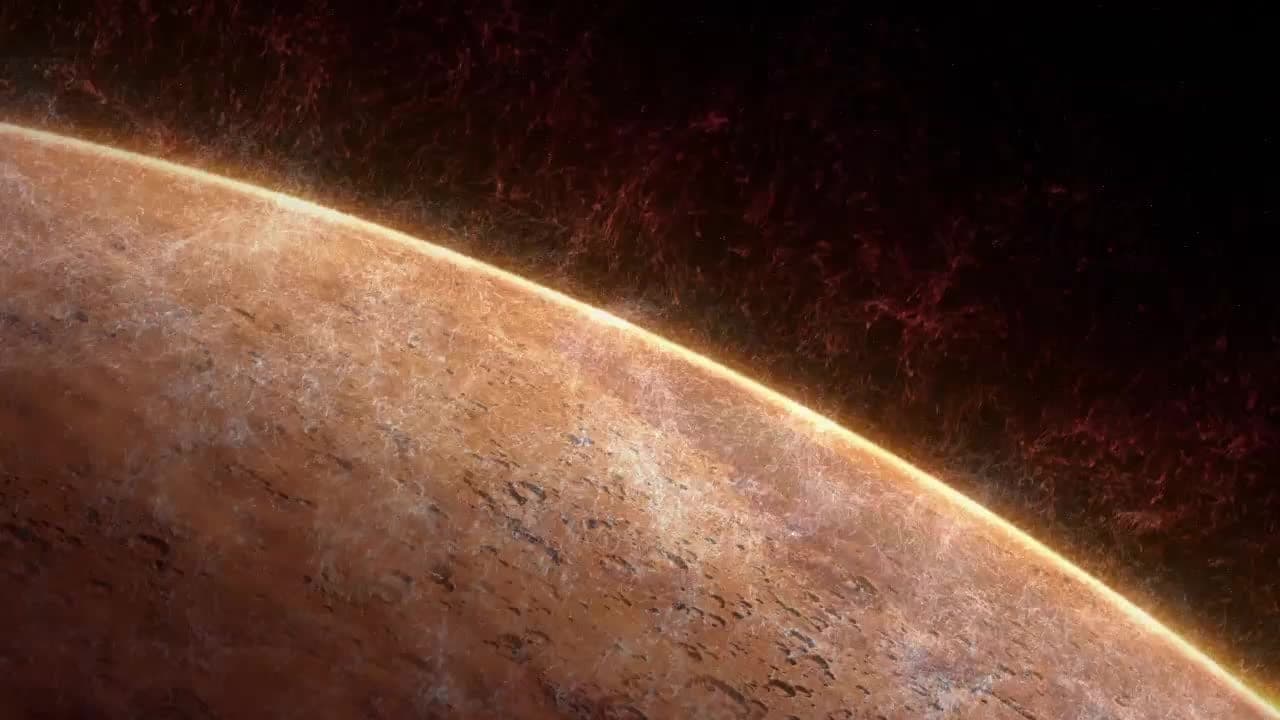
MAVEN launched on 18 November 2013 to study the one part of Mars nobody had gone to look at properly: the top of the atmosphere, and the boundary where it meets the solar wind. It very nearly did not go. The United States government shut down on 1 October 2013 with the launch seven weeks away and the next window 26 months off; work resumed only after the mission was declared an exception, on the grounds that it would be needed as a communications relay for the rovers already on the surface.
It arrived on 21 September 2014 into a deliberately stretched orbit, dipping to about 150 kilometres altitude and swinging out past 6,000, so that every lap sampled the whole vertical structure of the upper atmosphere. Several times the team lowered the low point further, to around 125 kilometres — the "deep dip" campaigns — flying close enough that atmospheric drag became a thing to manage rather than measure.
The headline number came in November 2015. Mars is losing roughly 100 grams of atmosphere to space every second. A quarter of a pound, continuously, for billions of years. Most of it goes down the induced magnetotail, with a smaller plume escaping over the poles. And the rate is not steady: in March 2015 an interplanetary coronal mass ejection struck while MAVEN was watching, and escape jumped by roughly an order of magnitude for the duration of the storm. Run that backwards through a younger, more violent Sun and the arithmetic gets serious.
MAVEN also saw things nobody had asked for. During a solar energetic particle event it recorded a diffuse aurora spread across the entire northern hemisphere, glowing down to about 60 kilometres altitude — deeper than aurora reaches at any other planet, because Mars has no global magnetic field to funnel charged particles to the poles, so they simply rain in everywhere at once. It also found an unexplained cloud of dust between 150 and 300 kilometres up, where nothing should be able to hold dust.
Then the total. In 2017 the team used the ratio of argon isotopes in the upper atmosphere as a record of cumulative loss and concluded that about two-thirds of the planet's argon is gone, implying at least half a bar of carbon dioxide stripped to space. That is how a world with rivers becomes a world with six millibars of air. No catastrophe required — just time, and no magnetic field to stand the wind off.
The spacecraft worked at Mars for eleven years, doubling as one of the relay links for Curiosity and Perseverance. On 6 December 2025 it passed behind Mars and emerged spinning fast enough to drain its batteries, and never answered again. NASA listened for months before formally closing the mission out on 3 June 2026, leaving the surface traffic to Odyssey, Mars Reconnaissance Orbiter and the Trace Gas Orbiter.