Mars accretes fast, then stops growing
Hafnium–tungsten dating puts Mars at half its present size within two million years of the solar system's birth. Then it quit growing, at a tenth of Earth's mass.
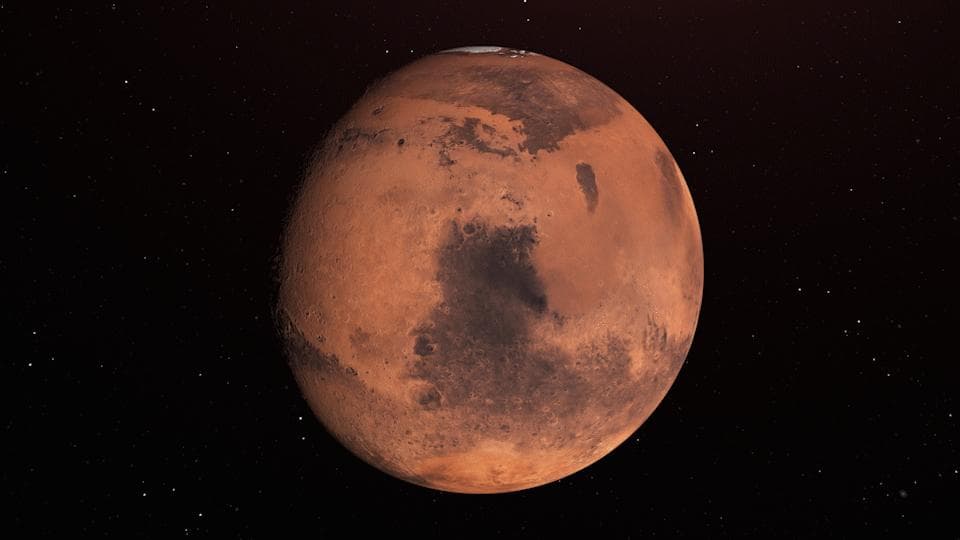
Mars was half its present size before the solar system was two million years old. Hafnium-182 decays to tungsten-182 with a half-life of about 8.9 million years, and because tungsten follows iron down into a planet's core while hafnium stays behind in the rock, a mantle's tungsten isotope ratio freezes at the moment the core closes. In 2011 Nicolas Dauphas and Ali Pourmand ran that clock on martian meteorites and got roughly 1.8 million years — a number earlier attempts had put anywhere between 0 and 15 million, because nobody could pin down the martian mantle's hafnium-to-tungsten ratio. Dauphas and Pourmand fixed it at 3.51 ± 0.45 and the ambiguity collapsed. Earth was still assembling tens of millions of years later; the impact that made its Moon did not land until somewhere between 50 and 150 million years in.
Then it stopped. The planet that resulted masses 6.42 × 10²³ kg — 10.7 percent of Earth — with a radius of 3,390 km, about half of ours. In the standard picture of rocky planet formation, embryos of that size go on colliding and merging until a few large survivors remain. Mars did not. It is a leftover: a planetary embryo that never got hit hard enough to grow up, preserved at the size Earth and Venus passed through on their way to becoming planets.
Why it stopped is not settled. Straightforward accretion simulations reliably produce a Mars several times too heavy — the "small Mars problem", one of the more stubborn failures in the field. The best-known fix is the Grand Tack, published by Kevin Walsh and colleagues in 2011: Jupiter migrates inward through the gas disc to about 1.5 AU, reverses when Saturn catches up and the two lock into resonance, and the round trip leaves a planetesimal disc truncated at roughly 1 AU. Earth's feeding zone survives. Mars's is gutted. It is elegant, and it is contested — it demands finely tuned timing for Saturn's growth, and rival models get a small Mars out of a disc that was simply depleted at its outer edge, with no giant-planet excursion at all.
The consequence is everything that follows. Surface gravity on Mars is 3.72 m/s², 38 percent of Earth's, which makes it far worse at holding onto gas molecules. A small body also carries a lot of surface area for its volume and sheds internal heat quickly, which decides how long a molten core can keep stirring. Mars was not made hostile by some accident later on. It was undersized inside the first few million years, and the rest of its history is that shortfall paying itself out.