Mariner 9 arrives into a planet-wide dust storm
The first spacecraft ever to orbit another planet reached Mars to find the surface hidden by dust. It waited, then mapped volcanoes, a 4,000 km canyon and dry riverbeds.
Mariner 9 was never meant to fly alone. Mariner 8 was to map most of the surface while Mariner 9 watched the planet change beneath it; instead Mariner 8 went into the Atlantic on 9 May 1971, four and a half minutes after launch, when a failed integrated circuit in the Centaur's pitch guidance module cost the upper stage its control. Both jobs were hurriedly rewritten onto the one survivor. Mariner 9 launched on 30 May, flew for 167 days, and on 14 November 1971 fired its engine for 15 minutes and 23 seconds to drop into orbit — the first spacecraft from Earth ever to orbit another planet.
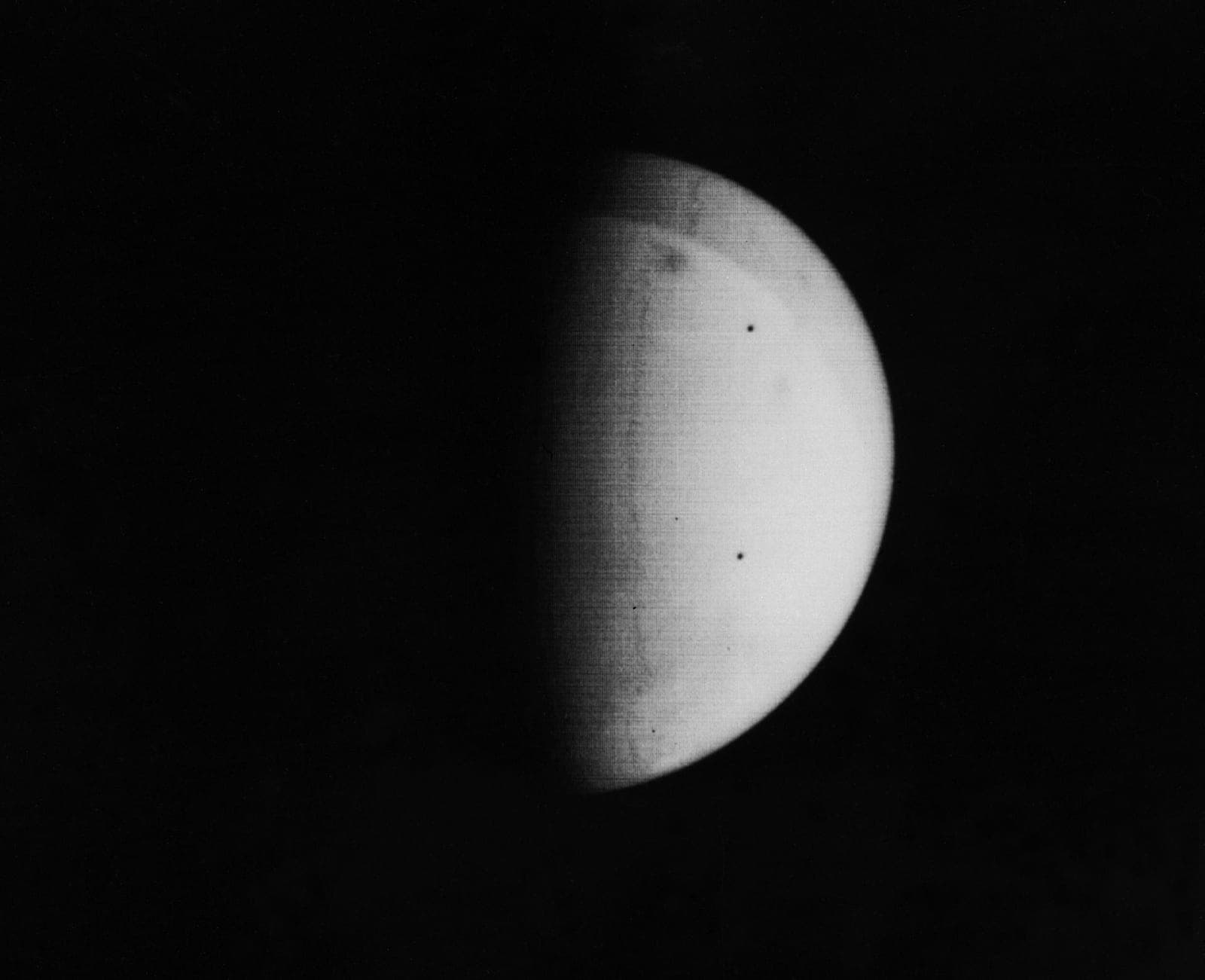
It arrived to find nothing to photograph. A dust storm that had begun on 22 September in the Noachis region had grown into one of the largest global storms ever recorded, and the entire surface was under an opaque haze. The first images came back as a featureless orange blank. Four dark spots showed through near Tharsis, and the south polar cap was faintly visible, and that was the whole of Mars. The team did the only sensible thing: they stopped the pre-loaded imaging sequence, put the spacecraft into a holding pattern, and waited. Nobody knew how long the storm would last.
It cleared through December and January, and the four dark spots resolved into the summits of the largest volcanoes in the solar system, poking through the dust. The biggest, then called Nix Olympica and now Olympus Mons, stands about 22 kilometres above the Mars datum. East of Tharsis the cameras found a canyon system more than 4,000 kilometres long and up to 7 kilometres deep, later named Valles Marineris after the spacecraft that found it. And threading across the older terrain were branching, sinuous channels with tributaries, islands and scour marks — features that on Earth are cut by running water.
By the time the attitude-control gas ran out on 27 October 1972, Mariner 9 had returned 7,329 images covering essentially the entire planet, plus the first close looks at Phobos and Deimos. It had also demolished the Moon-like Mars that Mariners 4, 6 and 7 had seemed to establish. The three earlier flybys had photographed the ancient southern highlands and concluded the planet was geologically dead; a single orbiter with global coverage showed active volcanism, tectonics, wind-driven dust on a planetary scale, and the unmistakable tracks of water that no longer exists. Mars stopped being a photograph and became a place with terrain and weather, and every mission since has been an argument about what happened to the water.