InSight listens to the inside of Mars
The first seismometer set directly on another planet's surface logged 1,300 marsquakes and sized a liquid core. Its heat probe never managed to bury itself.
InSight landed on Elysium Planitia at 19:52:59 UTC on 26 November 2018, in a spot chosen for being dull. No canyons, no outcrops, nothing worth driving to — which was fine, because the lander had no wheels. Everything it had come to do involved sitting still and listening on flat, soft, sunlit ground.
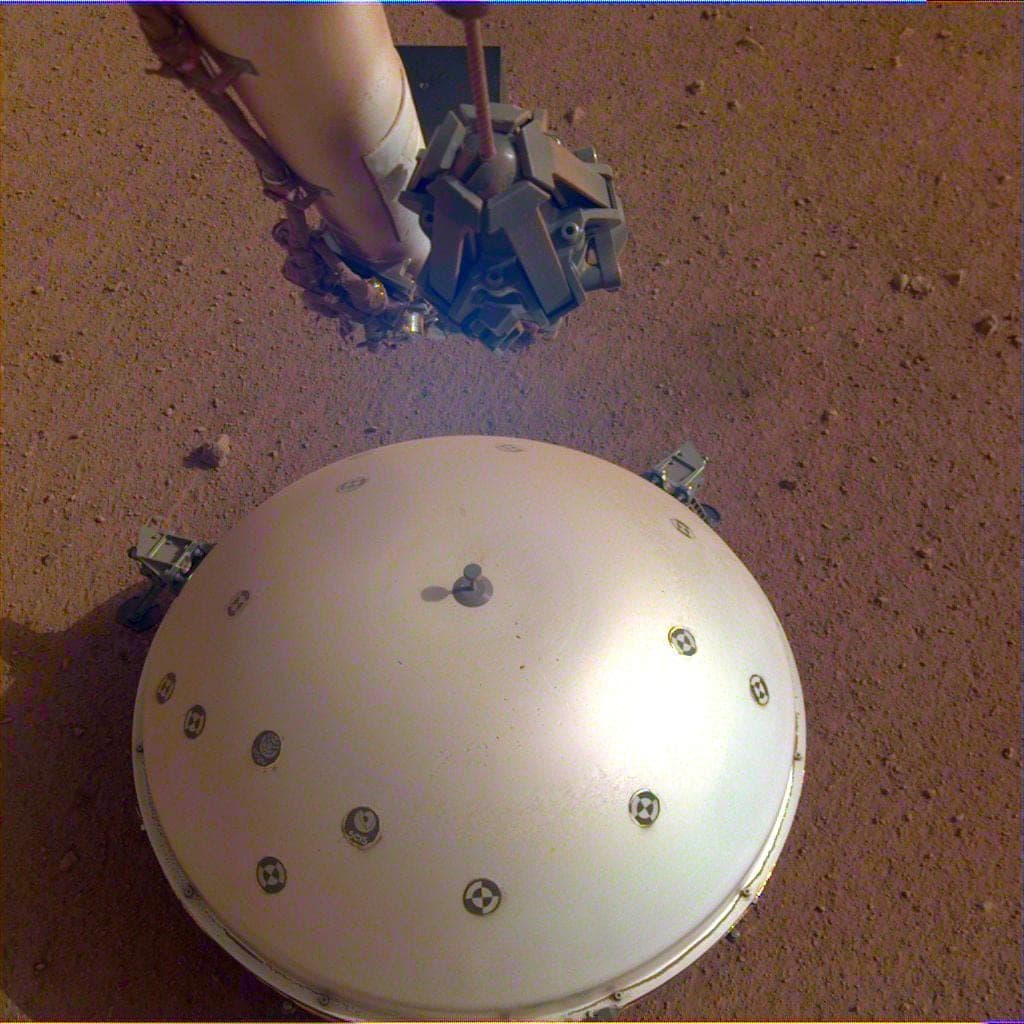
On 19 December the robotic arm lifted SEIS, a squat dome holding three very broadband and three short-period sensors, onto the dirt — the first seismometer ever placed directly on the surface of another planet. Viking 2 had carried one in 1976, bolted to the lander's deck, where it mostly recorded the lander rocking in the wind. SEIS got its own wind and thermal shield, and far quieter sensors.
The first plausible marsquake arrived on 6 April 2019, sol 128: far too faint to reveal anything about the interior, but the right shape. By mission's end SEIS had logged more than 1,300. Mars has no plate tectonics, so its quakes come from a cooling crust cracking under its own stress, clustered stubbornly around the Cerberus Fossae faults. The largest, on 4 May 2022, was put at magnitude 5 and later revised to about 4.7 — unremarkable in California, and enough to ring an entire planet.
The results landed in July 2021 in three simultaneous papers. The crust beneath the lander is layered — about 20 kilometres thick in two layers, or 37 in three, depending on the interpretation — and the mantle runs down some 1,560 kilometres. The core, the measurement InSight was built for, came out liquid, near 1,830 kilometres in radius, and too light to be pure iron: roughly a fifth of it must be sulfur, oxygen, carbon and hydrogen. In 2023 a further analysis found molten silicate lying on top of the core, shrinking the core itself to nearer 1,650 kilometres. Then in September 2025 Huixing Bi's group found two rare deep arrivals in the catalogue — PKKP, crossing the outer core, and PKiKP, reflecting off an inner-core boundary — and reported a solid inner core near 613 km. Anyone quoting a Mars core radius confidently is quoting a snapshot.
The other half of the payload simply failed. HP3, a German-built self-hammering probe universally called the mole, needed three metres of depth to measure the heat still leaking out of the interior — the number that constrains Mars's thermal history and how long it stayed warm enough for surface water. Hammering needs friction from the surrounding soil to push against, and Elysium's soil turned out to be a cohesive duricrust that clumped away from the probe rather than gripping it. Two years of improvisation followed: pressing with the arm's scoop, backfilling the pit. On 9 January 2021 it struck 500 more times, moved nowhere, and the team stopped; the 40-centimetre probe still lies with its top end a couple of centimetres under the surface. Mars's heat flow is still unmeasured.
Dust on the solar panels finished the rest: last contact, 15 December 2022.