A planet-wide dust storm finishes Opportunity
A dust cloud spotted on 30 May 2018 grew to cover Mars and blacked out the sky over a rover that had driven 45 km on a 90-day warranty.
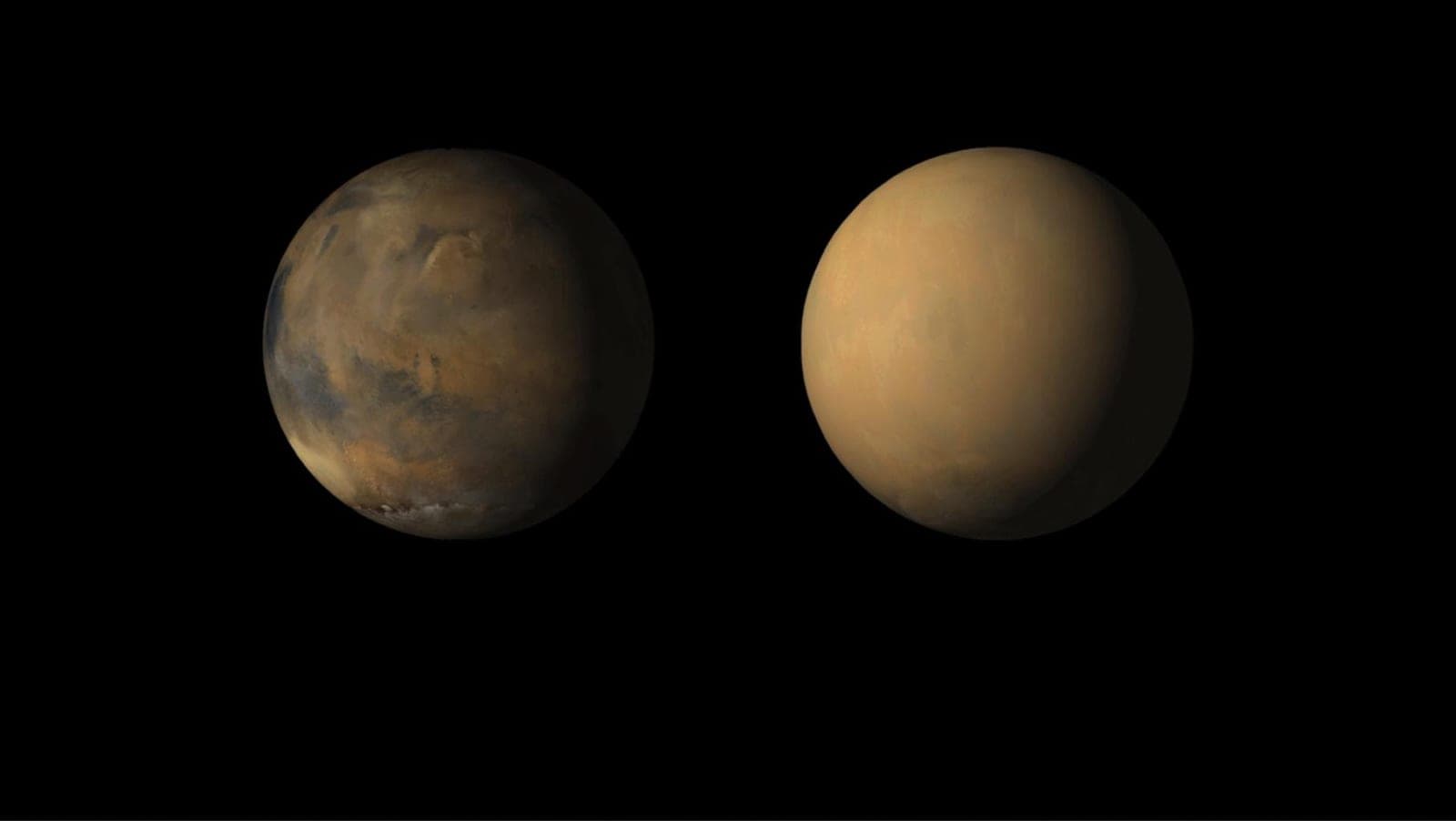
A small dust cloud showed up in the northern hemisphere on 30 May 2018. Bruce Cantor, who reads the daily weather images from Mars Reconnaissance Orbiter's colour imager, thought this one looked wrong and put the Opportunity team on notice within days. Three weeks later, on 20 June, he declared it a planet-encircling dust event.
Martian dust storms do not knock things over — the air is far too thin for wind to do real damage. They kill solar-powered spacecraft by switching off the Sun. Atmospheric opacity is measured as tau, and Opportunity had ridden out a tau of around 5 during the 2007 storm. This time tau over Endeavour Crater climbed past 10.8, the darkest sky ever measured from the martian surface. The rover's final transmission came on 10 June 2018: a power reading, and a sky too dark to charge from.
Then eight months of calling. JPL sent more than a thousand commands, working through every fault mode anyone could construct — mission clock fault, uploss timer fault, a receiver stuck on the wrong frequency — and waited out the windy season in the hope that a gust would sweep the panels clean, which had happened before. The last attempt went out on the night of 12 February 2019. NASA announced the end of the mission the following day.
What it had done by then was fourteen years, forty-five kilometres and the first hard chemistry of ancient water, all on a ninety-sol warranty. It died in a valley called Perseverance.
The famous last words — "my battery is low and it's getting dark" — were never transmitted. A reporter, Jacob Margolis, paraphrased the content of the final telemetry that way, and the line escaped into the world as a quotation. It is a clean example of how quickly we write feelings onto machines, and worth being honest about on a timeline that is otherwise a list of instruments.
The storm was not only an obituary. MAVEN and the Trace Gas Orbiter watched it loft water vapour to around 80 kilometres altitude, far above the level where it normally freezes out and into a region where ultraviolet light splits the molecule and the hydrogen escapes to space. Planet-encircling dust storms appear to be part of the machinery by which Mars dries out. The thing that killed Opportunity is a modern, miniature version of the process that ended the wet Mars it spent fourteen years documenting.